
Please Choose Your Language
- All
- Product Name
- Product Keyword
- Product Model
- Product Summary
- Product Description
- Multi Field Search

Views: 0 Author: Site Editor Publish Time: 2026-09-17 Origin: Site


Specifying the wrong insulation coating on magnet wire directly leads to premature component failure, thermal breakdown, and highly inefficient manufacturing processes. Engineers constantly face a strict tension between production efficiency and operational durability. Rapid soldering accelerates assembly lines, but high-load applications demand extreme thermal and mechanical stress resistance. You cannot simply swap one insulation type for another without severe consequences. Substituting materials without completely redesigning the termination process or thermal management system will inevitably compromise the final application.
A rigorous technical evaluation is necessary to align material properties with specific application environments and manufacturing constraints. Understanding the exact performance differences in polyester vs polyurethane enameled wire ensures your coil winding operations remain reliable under load. By matching the correct enamel chemistry to your baseline operating temperatures and termination methods, you prevent field failures and optimize manufacturing throughput.
Primary Trade-off: Polyurethane coatings prioritize manufacturing speed through direct solderability, while polyester coatings prioritize mechanical toughness and thermal endurance.
Thermal Class Distinctions: Polyester and its derivatives (like polyesterimide) generally offer superior resistance to higher operating temperatures (Class F, H, and C) compared to standard polyurethane, making them critical for high-load motors and transformers.
Production Impact: Specifying polyurethane eliminates the mechanical or chemical stripping phase during termination, significantly reducing cycle times in automated coil winding and assembly.
Base Metal Versatility: Both enamels can be applied to enameled copper wire and enameled aluminum wire, but the choice of base metal alters the overall thermal dissipation and mechanical flexibility of the finished coil.
Selecting the correct magnet wire requires establishing rigid operational parameters long before winding begins. You must define the baseline operating temperatures and anticipate peak thermal loads during fault conditions. Environmental exposures dictate the chemical resilience required from the insulation. Magnet wire rarely operates in a vacuum. It faces constant exposure to aggressive impregnating varnishes, encapsulation resins, industrial solvents, and ambient moisture. If the enamel cannot withstand the specific chemical makeup of your secondary potting compounds, the insulation will soften, leading to catastrophic turn-to-turn shorts.
Manufacturing throughput requirements heavily influence insulation selection. The methods used to terminate the coil dictate the viability of specific coatings. High-volume production lines relying on rapid dip soldering require enamels that act as their own flux. Conversely, applications utilizing mechanical crimping, ultrasonic welding, or insulation-displacement connectors (IDCs) rely on different mechanical properties. If your facility lacks automated stripping equipment, specifying an enamel that requires mechanical routing or chemical stripping will create massive bottlenecks and increase the risk of damaging the base conductor.
Form factor and winding stress introduce severe mechanical demands. The physical constraints of the coil directly impact the required mechanical adhesion and abrasion resistance of the enamel. High-speed automated winding machines subject the wire to extreme tension. Tight bend radii stretch the outer edge of the wire while compressing the inner edge. If the enamel lacks sufficient flexibility and adhesion, it will crack or flake off during winding. Furthermore, achieving a high slot fill factor in compact motor stators requires wire with a highly uniform coating build that resists scrape abrasion when forced into tight spaces.
Engineers must evaluate several mechanical factors during the specification phase:
Elongation limits of the base conductor under dynamic winding tension.
Springback characteristics after the wire passes through the winding nozzle.
Friction coefficients of the enamel surface, which dictate how easily wires slide past each other in the stator slot.
Adhesion strength of the enamel to the conductor during sharp 90-degree bends.
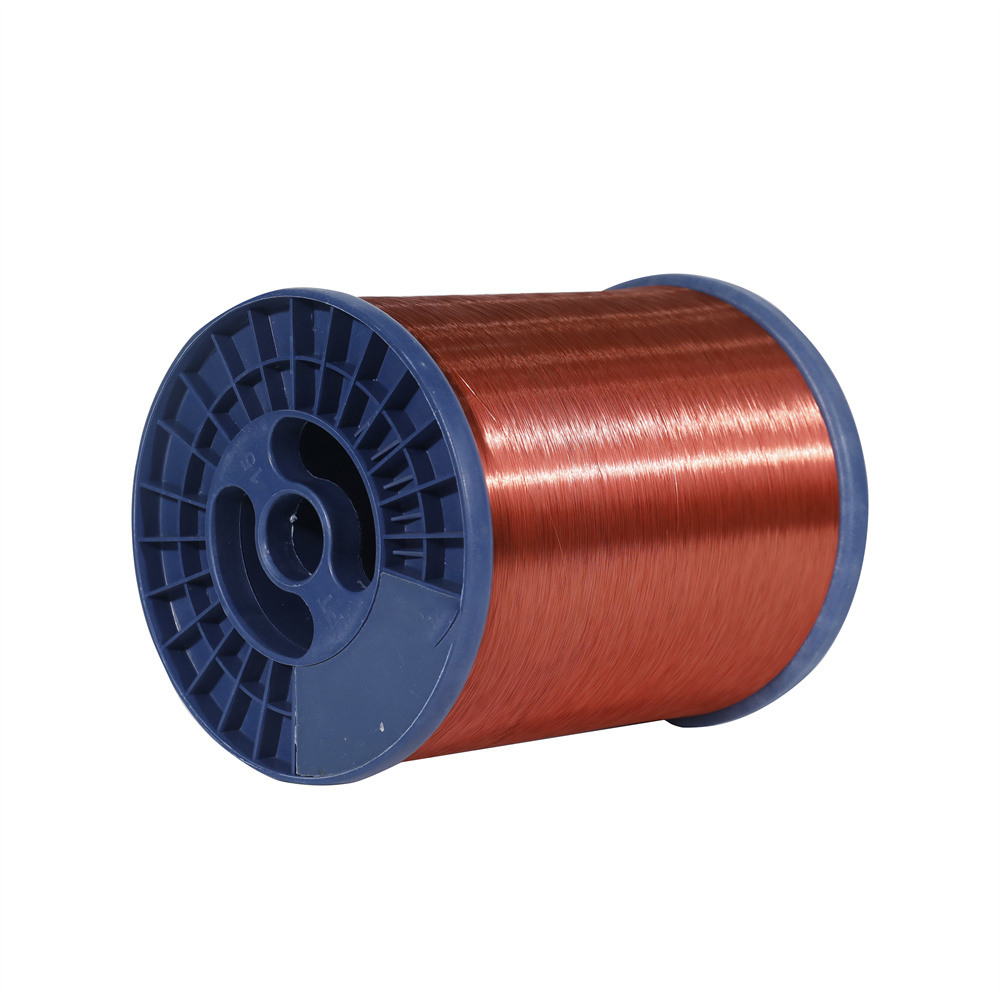
The defining feature of polyurethane enameled wire is its direct solderability. Under soldering heat, typically ranging from 360°C to 400°C, the polyurethane polymer structure breaks down. This chemical decomposition acts as a localized flux. It cleans the surface of the conductor and allows the solder to wet the metal perfectly without any prior mechanical or chemical stripping. This characteristic eliminates an entire step in the manufacturing process. For high-volume production of small coils, this translates to massive reductions in cycle time and eliminates the risk of nicking the conductor during stripping.
Beyond manufacturing speed, polyurethane offers excellent high-frequency performance. The material possesses specific dielectric properties that result in low dielectric loss. This makes it highly suitable for high-frequency electronic components where signal integrity and minimal energy dissipation are required. The enamel maintains a stable dielectric constant across a wide range of frequencies, preventing unwanted capacitance effects in precision wound components.
Standard applications leverage these specific traits. You will find polyurethane insulation heavily utilized in relays, micro-motors, ignition coils, and telecommunications equipment. Small transformers, audio coils, and various sensors also rely on this enamel due to the intricate nature of their terminations. When the wire gauge is exceptionally fine, mechanical stripping becomes nearly impossible without breaking the wire. Polyurethane solves this problem entirely.
The material has strict limitations regarding thermal ceilings and mechanical robustness. Standard NEMA and IEC thermal classes for polyurethane typically range from Class B (130°C) to Class F (155°C). While modified polyurethane formulations can reach Class H (180°C), they generally do not match the continuous thermal endurance of heavier enamels. Additionally, polyurethane exhibits lower resistance to certain aggressive industrial solvents and provides less protection against high mechanical abrasion during aggressive winding processes.
When deploying polyurethane in a production environment, operators must monitor specific variables:
Solder pot temperature calibration to ensure complete enamel vaporization.
Dwell time in the solder bath to prevent excessive heat transfer up the wire shaft.
Ventilation systems to extract the fumes generated by the decomposing polyurethane film.
When operational demands exceed the capabilities of polyurethane, polyester enameled wire becomes the standard choice. The core advantage lies in its thermal and mechanical robustness. Standard polyester provides a reliable Class F (155°C) rating. However, the industry heavily utilizes its upgraded derivative, polyesterimide. The cross-linked polymer structure of polyesterimide pushes the thermal rating to Class H (180°C) and even Class 200°C. This molecular structure provides exceptionally high cut-through resistance, ensuring the insulation does not fail when wires cross over each other under high physical pressure and elevated temperatures.
Advanced protection often requires dual-coated wire systems. A common and highly effective industry practice involves applying a polyesterimide base coat followed by a polyamide-imide overcoat. This combination achieves Class C (200°C+) ratings. The base coat provides excellent dielectric strength and thermal stability, while the topcoat delivers extreme resistance to scrape abrasion and chemical attack. This dual-layer approach is mandatory for components operating in extreme environments where failure is not an option.
Chemical and varnish compatibility is another major strength. Polyester and polyesterimide exhibit superior resistance to standard impregnating varnishes, encapsulation resins, and harsh industrial solvents. When a motor stator is dipped in varnish and baked, the wire enamel must not soften or react with the resin. Polyester maintains its integrity through aggressive curing cycles and resists degradation from compressor oils, refrigerants, and transmission fluids.
Ideal use cases encompass applications requiring high durability and continuous operation under heavy loads. Fractional and integral horsepower motors, heavy-duty industrial transformers, automotive alternators, and hermetic motors rely on this insulation. These applications generate significant heat and vibration, demanding an enamel that will not degrade over decades of continuous use.
The primary limitation of polyester is its termination requirement. The material is not self-fluxing. You must mechanically or chemically strip the insulation prior to soldering or welding. This adds a distinct step to the manufacturing process. Mechanical routing, wire brushing, or laser stripping requires specialized equipment and introduces the potential risk of nicking or reducing the cross-section of the base conductor, which can create localized hot spots.
The most critical divergence between these two materials lies in their thermal endurance. Standard NEMA and IEC classifications dictate continuous operating temperatures for a 20,000-hour lifespan. Polyurethane typically occupies the Class B (130°C) and Class F (155°C) tiers. While modified versions reach Class H (180°C), they remain vulnerable to sudden thermal spikes. Polyester, specifically polyesterimide, comfortably operates at Class H (180°C) and Class 200°C. When paired with a polyamide-imide overcoat, it handles Class C (220°C) environments.
Behavior under continuous thermal stress differs significantly. Polyurethane will eventually experience outgassing and embrittlement if pushed beyond its rated ceiling for extended periods. Polyester maintains its dielectric strength and physical flexibility much longer under continuous high-heat loads. During short-term thermal shock—such as a locked rotor condition in a motor—polyester resists thermoplastic flow (cut-through) far better than polyurethane, preventing immediate short circuits.
Direct-solderable polyurethane saves immense amounts of time and labor. In automated coil manufacturing, the ability to dip a wound bobbin directly into a solder pot and achieve perfect termination in three seconds is invaluable. It eliminates the need for stripping stations, reduces tooling wear, and minimizes handling time.
Stripping polyester requires dedicated tooling and process controls. Mechanical strippers use high-speed fiberglass wheels or carbide blades to physically remove the tough enamel. This requires frequent maintenance and calibration. Laser stripping offers precision but requires high initial capital investment. Chemical strippers involve handling hazardous materials and require thorough neutralization to prevent long-term corrosion. Any mechanical stripping method carries the inherent risk of damaging the conductor, which reduces the effective wire gauge and increases electrical resistance at the joint.
The solids content of the enamel formulation, which starts around 8% and scales up, dictates the final cured properties of the film. The specified build thickness—categorized as Single, Heavy, or Triple build—directly impacts mechanical toughness and flexibility. Heavy build polyester provides exceptional defense against scrape abrasion during high-speed automated winding. The wire can be pulled forcefully through winding nozzles and packed tightly into stator slots without exposing the bare metal.
Polyurethane, while flexible, generally exhibits lower scrape abrasion resistance. It is more susceptible to damage if the winding equipment is not perfectly calibrated or if the tooling has rough edges. Both coatings demonstrate excellent adherence to the conductor when subjected to tight bend radii and stretching, provided the wire is manufactured to strict NEMA MW 1000 or IEC 60317 standards.
Performance Metric | Polyurethane Enamel | Polyester / Polyesterimide Enamel |
|---|---|---|
Solderability | Directly solderable (Self-fluxing at 360°C - 400°C) | Requires mechanical, laser, or chemical stripping |
Standard Thermal Class | Class B (130°C) to Class F (155°C), modified to 180°C | Class F (155°C) to Class 200°C (with overcoats) |
Abrasion Resistance | Moderate; requires careful winding tension control | Excellent; withstands aggressive automated slot insertion |
Chemical Resistance | Susceptible to strong solvents and some varnishes | Highly resistant to refrigerants, oils, and potting resins |
Cut-Through Temperature | Lower threshold; vulnerable to high physical pressure | High threshold; maintains integrity under physical load |
Typical Applications | Relays, micro-motors, sensors, high-frequency coils | Heavy-duty motors, alternators, industrial transformers |
The choice of base metal interacts heavily with the chosen enamel. Enameled copper wire provides high electrical conductivity and high tensile strength. It withstands significant pulling tension during winding and offers excellent space factor due to its lower required cross-section for a given current. Copper accepts both polyurethane and polyester coatings flawlessly.
Enameled aluminum wire offers a lightweight alternative, but it presents unique engineering challenges. Aluminum has lower tensile strength, meaning winding speeds and tensions must be reduced to prevent wire breakage. When applying polyurethane to aluminum for direct soldering, you face the challenge of aluminum oxide. While the polyurethane acts as a flux, aluminum oxide forms instantly upon exposure to air and is highly resistant to standard solder. Soldering enameled aluminum usually requires highly aggressive fluxes and specialized solder alloys combined with ultrasonic solder pots to break the oxide layer mechanically while the polyurethane burns off.
Deploying any magnet wire at scale introduces specific manufacturing risks. Understanding these failure modes allows you to implement robust mitigation strategies before production begins.
A primary risk with polyurethane is incomplete soldering. If the solder pot temperature drops, or if the dwell time is too short, the polyurethane film will not fully decompose. This leaves a resistive residue trapped inside the solder joint, leading to high contact resistance and eventual thermal failure of the connection. To mitigate this, establish strict thermal profiling. Continuously monitor solder pot temperatures and implement automated dip-timing controls to ensure the wire experiences the exact thermal energy required for complete enamel vaporization.
When utilizing polyester, the main risk involves conductor embrittlement or cross-sectional reduction during mechanical stripping. Aggressive wire brushing can shave off microscopic layers of the copper or aluminum, creating a weak point that will fracture under vibration. Mitigation requires moving away from manual stripping. Implement precision laser stripping systems that vaporize the polyester without heating or touching the underlying metal. If using automated mechanical strippers, enforce strict quality control tolerances and mandate frequent blade inspections under magnification.
Chemical incompatibility between the enamel and secondary potting compounds is a hidden risk that often manifests months after deployment. Certain epoxies or varnishes contain solvents that can attack the insulation over time, causing it to swell and lose dielectric strength. Mitigation requires mandatory compatibility testing prior to full-scale production. Conduct sealed tube tests where the enameled wire and the potting compound are sealed in a glass tube and baked at elevated temperatures for hundreds of hours. Subsequent dielectric breakdown testing will reveal any chemical degradation.
Off-the-shelf enamels do not solve every engineering challenge. You must identify scenarios where standard configurations are insufficient. Applications requiring specific heavy builds for extreme abrasion resistance, polyamide-imide overcoats for surge protection in inverter-duty motors, or self-bonding layers for bobbin-less voice coils require specialized manufacturing. This is when you must specify custom magnet wire tailored to your exact operational environment.
Evaluating supplier capabilities is critical. A reliable magnet wire manufacturer must possess comprehensive in-house testing laboratory capabilities. They should routinely perform tangent delta testing to verify enamel cure, high-voltage pinhole testing to ensure continuous dielectric integrity, and thermoplastic flow testing. Demand strict adherence to NEMA MW 1000 or IEC 60317 standards. Lot-to-lot consistency is non-negotiable; a slight variation in enamel concentricity can derail an entire automated winding line.
Before committing to high-volume orders, establish a rigorous prototyping phase. Request sample spools of the custom wire for initial winding trials. Run these spools through your actual production equipment at full speed to verify abrasion resistance and tooling compatibility. Perform destructive testing on the wound prototypes, including thermal shock cycling and surge testing, to validate that the custom enamel meets your theoretical design parameters.
Finalizing your magnet wire specification requires strict adherence to operational data rather than assumptions. You must map the exact thermal loads, chemical exposures, and mechanical stresses your coils will endure in the field. Relying on standard polyurethane for high-temperature environments will cause rapid insulation failure, while forcing polyester into a high-speed, direct-solder assembly line will destroy your production efficiency.
Audit your current winding equipment to determine maximum safe tension limits and tooling compatibility for heavy-build enamels.
Map the peak thermal loads of your application under fault conditions to establish a hard baseline for NEMA thermal class requirements.
Run a pilot batch of sample spools through your actual production line to verify solderability or stripping efficiency before placing bulk orders.
Standardize your termination process by calibrating solder pot temperatures or laser stripping parameters to match the specific chemistry of the chosen wire.
A: No. They possess vastly different thermal ceilings and termination requirements. Swapping them without re-engineering your manufacturing process and thermal management system leads to production bottlenecks or premature field failures due to thermal breakdown.
A: Standard polyester is not self-fluxing and requires mechanical, laser, or chemical stripping before soldering. Unlike polyurethane, it will not decompose cleanly in a standard solder pot. Modified enamels exist, but they require complex, high-heat stripping processes.
A: Standard polyurethane thermal classes range from Class B (130°C) to Class F (155°C). While chemically modified versions reach Class H (180°C), they do not offer the continuous thermal stability and mechanical toughness of higher-temperature polyester alternatives.
A: The choice depends on weight and space constraints. Aluminum offers significant weight reduction but requires a larger cross-section to match copper's conductivity. Copper provides superior tensile strength and space efficiency. Both metals readily accept polyester or polyurethane coatings.
A: Polyesterimide is a chemically modified, upgraded version of standard polyester. The addition of imide groups into the polymer chain provides significantly higher thermal resistance (Class H/180°C to Class 200°C) and superior mechanical cut-through resistance compared to standard Class F polyester.


