
Please Choose Your Language
- All
- Product Name
- Product Keyword
- Product Model
- Product Summary
- Product Description
- Multi Field Search

Views: 0 Author: Site Editor Publish Time: 2026-09-10 Origin: Site


Specifying the correct thermal class for magnet wire is a strict engineering decision. A mere 25°C difference dictates maximum temperature exposure, operational lifespan, failure rate, and the manufacturing complexity of wound components. Engineers and procurement teams frequently struggle to balance thermal headroom against manufacturing efficiency. Upgrading from a 130°C to a 155°C rating directly impacts solderability, insulation chemistry, and material selection.
Supply chain realities are forcing manufacturers to transition. The increasing obsolescence of legacy 130°C poly-nylon wires leaves production lines vulnerable. Conversely, under-specifying thermal limits risks catastrophic breakdown in motors and transformers. Evaluating the shift between 130 vs 155 class magnet wire requires a strict analysis of insulation materials, NEMA specifications, wire gauge constraints, and termination processes. This guide details the exact technical and operational changes to inform specification decisions.
Thermal Headroom: 155 class wire offers a 25°C continuous operating temperature advantage over 130 class, significantly reducing the risk of insulation degradation in high-load or enclosed applications.
Insulation Chemistry Shifts: Moving from 130 to 155 often involves transitioning from standard polyurethane or polyurethane-nylon blends to advanced polyurethane-155 or polyester-based resins, altering chemical resistance and flexibility.
Supply Chain & Obsolescence: Legacy 130°C Polyurethane-Nylon (MW 28) is increasingly marked as "No Longer Available" by major manufacturers, accelerating the industry-wide shift toward 155°C alternatives.
Termination Realities: While 130 class wire is universally solder-strippable at lower temperatures, 155 class polyurethane maintains quick solderability (especially in 30 AWG and finer gauges) but requires higher solder bath temperatures, impacting automated production lines.
Standardization: Upgrading necessitates a shift in NEMA MW 1000 specifications (e.g., moving from MW 28 to MW 79 or JW1177/41), requiring updated compliance documentation and quality control parameters.
The 130°C (266°F) continuous operating temperature threshold is defined under standard NEMA and IEC testing protocols. This rating guarantees the insulation maintains its dielectric properties for a 20,000-hour life curve at the specified temperature. Testing laboratories utilize the Arrhenius equation to plot thermal degradation over time, ensuring the enamel film does not become brittle or lose its insulating capability prematurely. Engineers specify 130 class enameled wire for low-voltage transformers, relays, and consumer electronics. These applications operate in controlled environments where extreme thermal spikes are rare.
Baseline insulation materials for Class B rely primarily on standard polyurethane and polyurethane-nylon blends. These resins are highly valued on the shop floor for their rapid, low-temperature solderability. Production lines terminate these wires without prior mechanical stripping, saving cycle time and reducing tooling wear. However, market availability is shifting. Many manufacturers are actively phasing out 130°C Polyurethane-Nylon (NEMA MW 28). This obsolescence pushes procurement teams to seek 155°C equivalents to maintain stable production volumes. We see winding facilities forced to update their bill of materials simply because their legacy 130°C spools are no longer stocked by primary suppliers.
Class F designates a 155°C (311°F) continuous operating temperature threshold. This higher rating provides a buffer against thermal degradation. Typical applications include fractional horsepower motors, automotive coils, and industrial transformers. These components demand higher thermal endurance and frequently face maximum temperature exposure during heavy duty cycles. Achieving this rating requires an insulation shift. Manufacturers utilize modified polyurethane-155 or polyester blends to reach the higher thermal index. The chemical modification increases the cross-linking density of the polymer chains, ensuring the wire does not sacrifice dielectric strength under heat stress.
Gauge-specific production plays a major role here. Polyurethane-155 is produced primarily in 30 AWG and finer gauges. This specific sizing facilitates quick soldering in compact wound components, balancing thermal resistance with manufacturing speed. Upgrading to 155 class enameled wire secures long-term reliability for high-stress applications. When a motor locks its rotor, that extra 25 degrees prevents immediate insulation failure. The modified resins also demonstrate superior performance during mandrel bend tests, proving their flexibility remains intact even after prolonged exposure to elevated operating temperatures.
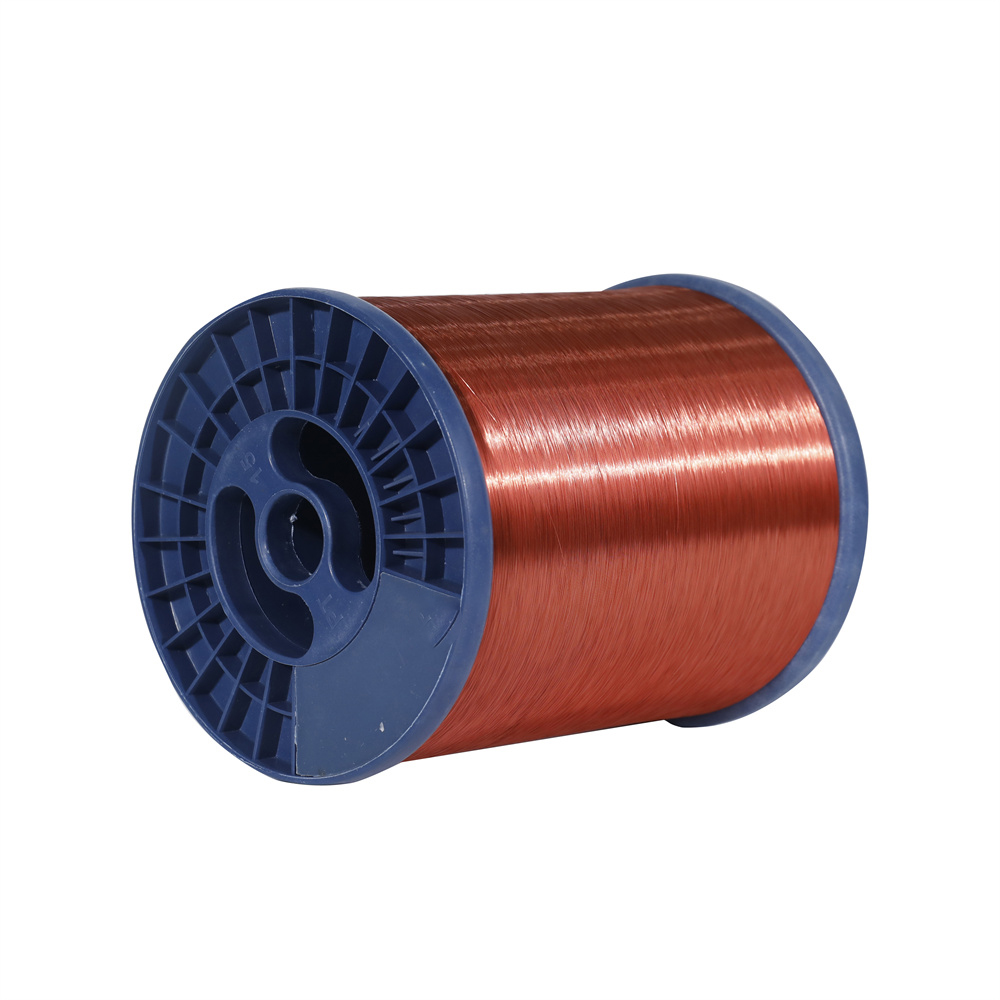
Thermal shock resistance varies significantly between the two classes. When subjected to sudden temperature spikes, 155 class insulation maintains its structural integrity far better than its 130 class counterpart. Transient overloads, such as locked rotor conditions in electric motors, generate immense heat in seconds. Under identical stress, 130 class insulation degrades faster, leading to premature short circuits. We measure this endurance using twisted pair testing, where the 155 class consistently outlasts the 130 class under high-voltage stress at elevated temperatures.
Operating environment ambient temperatures directly impact the derating curves of both wire classes. A motor operating in a 40°C ambient environment has less thermal headroom before reaching its insulation limit. The extra 25°C provided by Class F insulation allows components to run harder and longer without crossing the failure threshold. This capability drastically reduces field failure rates in demanding industrial environments. Engineers must calculate the temperature rise of the coil under full load and add it to the maximum ambient temperature to ensure the selected wire class provides adequate protection.
Performance Metric | 130 Class (Class B) | 155 Class (Class F) |
|---|---|---|
Continuous Operating Temp | 130°C (266°F) | 155°C (311°F) |
Primary Insulation Chemistry | Polyurethane, Poly-Nylon | Modified Polyurethane, Polyester |
Direct Solderability | Excellent (360°C - 380°C) | Good (390°C - 400°C+) or None (Polyester) |
NEMA Specification Standard | MW 28 (Phasing out) | MW 79, JW1177/41 |
Transient Overload Tolerance | Low to Moderate | High |
Varnish Chemical Resistance | Poor to Fair | Excellent (Polyester variants) |
Analyzing standard 130°C polyurethane against modified 155°C polyurethane reveals distinct chemical differences. The transition to MW 79 or JW1177/41 standards requires changes in resin cross-linking. This tighter molecular structure provides the necessary thermal stability. Standard polyurethane enameled wire melts away cleanly at lower temperatures, but the modified 155°C version resists heat flow longer. The chemical modifiers added to the 155°C polyurethane prevent the polymer chains from breaking down rapidly, which is why it requires more thermal energy to strip during soldering.
Polyester is frequently introduced at the 155°C level for applications demanding superior mechanical toughness. It offers excellent solvent resistance, making it ideal for components subjected to harsh varnishes or encapsulation processes. Solvents like xylene and toluene, commonly found in industrial varnishes, can attack standard polyurethane, causing it to swell and lose dielectric strength. This contrasts sharply with the chemical limitations of polyurethane. Choosing polyester enameled wire guarantees structural rigidity during high-speed automated winding. The polyester film withstands the friction of winding nozzles and tensioners much better than standard polyurethane, reducing the risk of bare spots on the finished coil.
Manufacturing trade-offs become highly visible during the termination phase. Class 130 polyurethane allows direct soldering at roughly 360°C to 380°C. This lower temperature protects delicate components from heat stress and extends the life of soldering equipment. Production runs smoothly with minimal flux requirements. Operators experience fewer issues with dross buildup in the solder pots, keeping maintenance schedules predictable and manageable.
Termination changes drastically for 155 class wires. Polyurethane-155 requires higher solder bath temperatures, typically ranging from 390°C to well over 400°C. This elevated heat increases the risk of copper dissolution, especially in ultra-fine gauges where the conductor can literally melt away into the solder bath. Component heat stress also becomes a major concern for adjacent plastics or printed circuit boards. If a 155 class polyester wire is selected for its chemical resistance, it loses direct solderability entirely. Production lines must implement mechanical stripping, rotary blade strippers, or chemical removal methods before termination. You cannot simply dip a polyester-coated wire into a solder pot and expect a reliable electrical connection.
Copper serves as the baseline conductor for most high-performance wound components. It delivers exceptional electrical conductivity and excellent tensile strength. These properties allow for tighter winding tensions and smaller overall component footprints. Enameled copper wire handles the mechanical stress of high-speed winding machines without stretching or breaking easily. The annealing process during manufacturing ensures the copper has minimal springback, allowing coils to retain their precise shape after winding.
The thermal expansion of copper interacts uniquely with 130 and 155 class insulations during thermal cycling. Copper expands less than aluminum when heated. This lower expansion rate puts less mechanical stress on the enamel coating. Adhesion and flexibility retention remain high over thousands of thermal cycles. Modified 155 class resins bond securely to the copper substrate, preventing micro-cracking even under continuous vibration. The strong adhesion prevents moisture ingress, which is critical for maintaining high insulation resistance in humid operating environments.
Aluminum provides a lightweight, cost-effective alternative to copper. It reduces the overall weight of large transformers and motors significantly. However, utilizing enameled aluminum wire at these thermal classes introduces specific engineering challenges. Aluminum possesses a higher coefficient of thermal expansion compared to copper. When the coil heats up under load, the aluminum conductor expands outward, stretching the insulation film.
This expansion requires insulation with superior elasticity. Rigid coatings will crack as the aluminum expands and contracts during operational thermal cycling. Engineers favor specific 155 class modified resins to prevent this micro-cracking. Historically, NEMA recognized Single and Heavy Polyurethane-Nylon Coated Round Aluminum Magnet Wire at 130°C. Today, combining aluminum conductors with 155 class solderable insulation introduces termination complexities. Aluminum oxidizes rapidly upon exposure to air, forming a tough dielectric oxide layer. This requires specialized fluxes or aggressive mechanical crimping to ensure reliable electrical connections. You must pierce the oxide layer to achieve low contact resistance and prevent localized heating at the terminal joint.
Mapping the exact specification changes is necessary when upgrading thermal classes. The shift from MW 28 (Polyurethane-Nylon 130) to MW 79 or JW1177/41 (Polyurethane 155) alters multiple testing parameters. Dielectric breakdown requirements become more stringent to account for the higher operating temperatures. The insulation must prove it can withstand high voltage without failing while hot. Testing protocols dictate specific volts-per-mil requirements that the enamel must pass after thermal conditioning.
Continuity testing, also known as pinhole testing, ensures the enamel film is uniform. The MW 79 standard dictates strict limits on allowable faults per hundred feet of wire, typically tested using high-voltage sponge or bare wire contact methods. Thermoplastic flow, or cut-through temperature, is another critical metric. The 155 class insulation must resist softening and flowing away from the conductor at much higher temperatures than the 130 class. This prevents short circuits between adjacent turns in tightly wound coils where mechanical pressure and heat combine to stress the insulation film.
Recent changes to ANSI/NEMA MW 01000-2025 impact how engineers specify wire. A notable revision corrected a legacy Thermal Class 130 requirement to 155 for specific solderable applications. This update aligns the standard with current manufacturing realities and material capabilities. Staying compliant requires updating internal procurement documents to reflect these new baselines. Failure to update specifications can result in receiving non-compliant wire that fails during high-temperature validation testing.
These standards dictate precise dimensional tolerances. They also establish optical specifications for automated inspection systems on winding lines. Film build variations are strictly categorized into single, heavy, and specialized glass fiber covered or varnish-treated options. Adhering to the updated NEMA specifications guarantees the wire will perform predictably during both manufacturing and field operation. We rely on these optical standards to calibrate inline laser micrometers during extrusion, ensuring the enamel thickness remains perfectly concentric around the bare conductor.
Defining application-specific criteria is the first step in selecting the right thermal class. You must calculate the maximum operating ambient temperature and the expected duty cycle. Continuous operation demands higher thermal endurance than intermittent use. Space constraints also dictate the required fill factor. The fill factor represents the ratio of copper volume to the available winding window area. If space is tight, you may need thinner insulation or a more conductive material to achieve the required magnetic field strength without exceeding dimensional limits.
Wire gauge requirements heavily influence the decision. Polyurethane-155 is highly optimized for 30 AWG and finer gauges, making it perfect for miniature electronics, relays, and small sensors. Chemical resistance is another critical factor. If the wound coil will undergo vacuum pressure impregnation (VPI) with harsh varnishes, polyester insulation provides the necessary chemical barrier that standard polyurethane lacks. The VPI process forces varnish deep into the coil under pressure, and weak insulation will dissolve, causing immediate turn-to-turn shorts.
Analyzing the material cost delta between 130 and 155 class resins reveals a slight premium for the higher thermal rating. Modified polyurethane and advanced polyester blends cost more to synthesize and apply during the enameling process. However, this initial spool cost must be weighed against long-term reliability and manufacturing stability. Procurement departments should factor in the reduction of warranty claims when justifying the higher spool price.
The reduced failure rate of 155 class wire offsets the higher upfront material expense. Avoiding obsolete 130 class supply chain issues prevents costly production line halts. Upgrading ensures scalable, uninterrupted manufacturing. While tooling adjustments may be required initially, the long-term stability of sourcing a modern 155 class wire provides a superior cost-to-performance ratio for high-volume production. Standardizing on 155 class wire across multiple product lines also reduces inventory complexity and minimizes the risk of operators loading the wrong thermal class onto a winding machine.
The primary risk when upgrading to 155 class polyurethane involves solder pot temperature limitations. Existing manufacturing lines calibrated for 130 class wire may struggle to reach or maintain the 390°C+ required for clean termination. Insufficient heat leads to poor solder joints, increased electrical resistance, and incomplete removal of the enamel film. Operators will notice a gummy residue left on the wire, indicating the temperature is too low to vaporize the modified polyurethane.
Mitigation requires active profiling of solder baths. You must ensure the equipment can sustain higher temperatures without damaging adjacent components or causing excessive dross formation. Upgrading flux chemistries can also accelerate the stripping process at slightly lower temperatures. If adopting 155 class polyester, direct soldering is impossible. You must transition the production line to mechanical crimping, insulation displacement connectors (IDCs), or welded terminations to ensure reliable connections. We often install automated mechanical strippers on lines transitioning to polyester to maintain throughput speeds without relying on thermal stripping.
Take the following actions to update your magnet wire specifications and manufacturing processes:
Audit your current solder bath equipment to verify it can sustain continuous temperatures above 390°C without excessive temperature drops during high-volume dipping.
Update your internal procurement documents from legacy NEMA MW 28 to MW 79 or JW1177/41 to secure a stable, long-term supply chain.
Test varnish compatibility thoroughly if transitioning to 155 class wire, ensuring the new enamel does not degrade during encapsulation.
Implement mechanical stripping or insulation displacement connectors (IDCs) if your application requires the chemical resistance of 155 class polyester.
A: Yes, electrically and dimensionally they are often identical. However, you must adjust your manufacturing process. 155 class polyurethane requires higher solder bath temperatures (390°C+), and 155 class polyester requires mechanical or chemical stripping before termination.
A: Manufacturers are phasing out 130°C MW 28 because modified 155°C resins now offer superior thermal performance with similar solderability. Consolidating production lines to 155 class materials reduces manufacturing costs and simplifies global supply chains.
A: Not necessarily. The thermal class dictates temperature endurance, not film thickness. Both 130 and 155 class wires are available in single, heavy, and triple film builds according to standard NEMA dimensional tolerances.
A: It depends on the specific chemistry. A 155 class polyester wire offers excellent solvent and varnish resistance. However, a 155 class polyurethane wire remains susceptible to aggressive solvents, similar to 130 class polyurethane.
A: Aluminum expands more than copper under heat. When using aluminum, a 155 class insulation with high elasticity is crucial to prevent the enamel from micro-cracking during thermal cycling in high-load applications.
A: If the solder bath cannot reach the required 390°C–400°C+, the polyurethane insulation will not burn off completely. This leaves residue on the conductor, resulting in cold solder joints, high electrical resistance, and potential component failure.


