
Please Choose Your Language
- All
- Product Name
- Product Keyword
- Product Model
- Product Summary
- Product Description
- Multi Field Search

Views: 0 Author: Site Editor Publish Time: 2026-09-24 Origin: Site


High-stress electromagnetic applications—such as EV traction motors, aerospace actuators, and heavy-duty transformers—demand precise insulation resin selection to prevent catastrophic short circuits and thermal degradation. Specifying the wrong enamel coating leads to premature insulation failure, either through mechanical abrasion during high-speed winding processes, thermal overload during continuous operation, or chemical breakdown in harsh environments. Evaluating the distinct chemical, mechanical, and thermal properties of polyesterimide and polyamide-imide resins helps engineering teams balance performance, longevity, and manufacturing yields in high-temperature applications. When analyzing polyesterimide vs polyamide-imide magnet wire, understanding their baseline characteristics ensures optimal system reliability.
Thermal Thresholds: Both resins support high-temperature environments, but polyamide-imide (PAI) generally offers superior continuous thermal stability (up to Class 220) compared to standard polyesterimide (PEI) (Class 180 to 200).
Mechanical Durability: PAI provides exceptional abrasion resistance and toughness, making it highly suitable for rigorous, high-speed automated winding processes.
Chemical & Flame Resistance: PAI exhibits higher resistance to aggressive solvents, refrigerants, and offers inherent flame resistance, which is critical for hermetic motor and aerospace applications.
The Dual-Coat Standard: Rather than strictly competing, these resins are most frequently utilized in tandem (PEI base coat with a PAI topcoat) to achieve an optimal balance of dielectric strength, mechanical protection, and cost-efficiency.
Polyesterimide is a highly versatile polymer engineered by combining ester and imide linkages within its molecular chain. The ester groups provide flexibility and excellent adhesion to metal substrates, while the imide groups deliver high thermal stability. This chemical structure creates a robust insulation layer capable of withstanding significant operational stress across thousands of hours of continuous use.
Engineers primarily specify polyesterimide enameled wire for its exceptional dielectric properties and strong thermal endurance. It typically qualifies as Class 180 or Class 200 insulation. The resin bonds aggressively to bare conductors, preventing delamination during thermal cycling. It also offers a smooth surface finish, which aids in moderate winding applications where extreme friction is not the primary concern.
Common use cases include general-purpose industrial motors, standard dry-type transformers, and magnetic coils. In advanced applications, manufacturers utilize polyesterimide as the foundational base coat in multi-layer insulation systems. They rely on its high dielectric breakdown voltage to provide the primary electrical barrier between adjacent copper or aluminum turns.
Polyamide-imide is an amorphous thermoplastic polymer containing both amide and imide functional groups. This specific molecular arrangement yields a material with extreme mechanical toughness, superior flexibility, and an exceptionally high thermal rating, typically ranging from Class 200 to Class 220. The polymer chain structure allows it to absorb mechanical impacts without fracturing.
When engineering high-stress components, polyamide-imide enameled wire stands out due to its unmatched chemical resistance and surface hardness. It bridges a known gap in polymer science. Pure polyimide (PI) offers maximum thermal stability but suffers from poor flexibility and weak substrate adhesion. PAI solves this by incorporating amide groups, which enhance flexibility and adhesion without sacrificing the high-temperature capabilities inherent to imide structures.
Manufacturers deploy PAI in aerospace components, EV traction motors, and hermetic compressors. Because of its high raw material cost and processing complexity, it is most frequently applied as a thin, highly protective topcoat over softer base resins rather than as a standalone single coat. This layered approach maximizes the mechanical benefits while controlling production expenses.
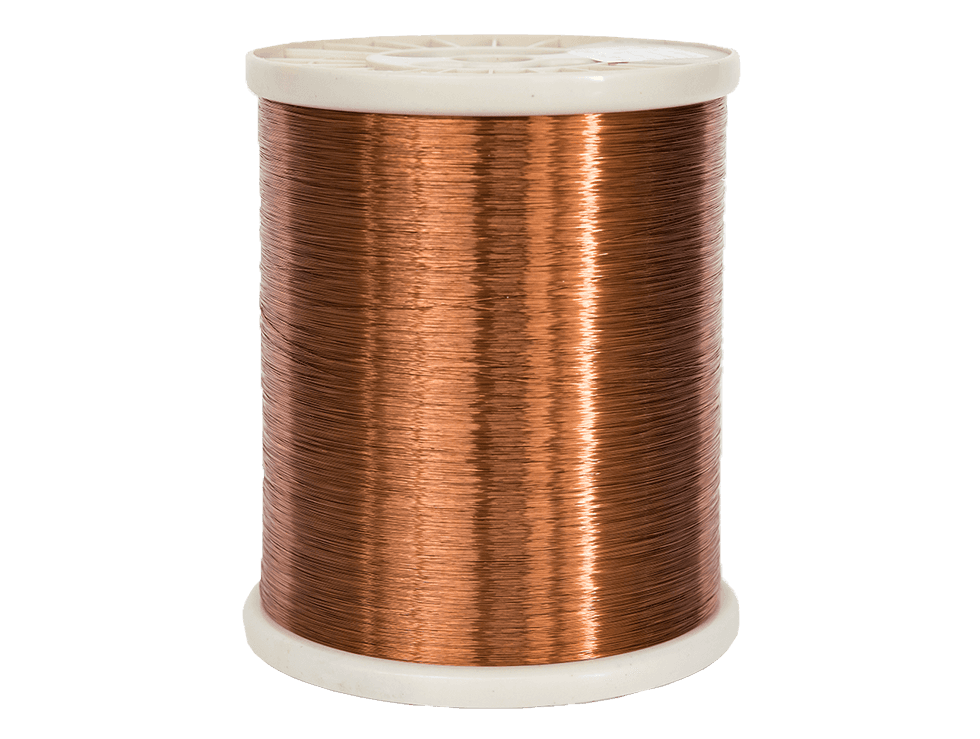
Thermal endurance dictates the lifespan of any electromagnetic coil. Polyesterimide generally carries a continuous service temperature rating of 180°C to 200°C. Polyamide-imide pushes this boundary further, comfortably operating at 200°C to 220°C continuously. When specifying class 200 magnet wire, the choice between these resins depends heavily on peak load expectations rather than just baseline continuous operation.
Thermal shock resistance and thermoplastic flow—often measured as the cut-through temperature—reveal distinct differences under high-load conditions. When wires cross over each other in a tightly packed stator slot, high temperatures combined with physical pressure can cause the enamel to soften and flow, leading to a short circuit. PAI exhibits a significantly higher cut-through temperature than PEI, maintaining its structural integrity under extreme mechanical pressure at elevated temperatures. Standard tests often show PAI resisting cut-through at temperatures exceeding 350°C, whereas standard PEI might fail closer to 300°C.
Degradation behaviors also diverge during extreme intermittent temperature spikes. PAI demonstrates a remarkable ability to withstand intermittent exposures approaching 300°C without immediate catastrophic failure. Furthermore, the imide-heavy polymer chains in PAI provide inherent flame resistance and self-extinguishing properties, a necessary safety factor in aerospace and enclosed industrial environments where fire propagation must be halted instantly.
Automated winding equipment subjects magnet wire to severe mechanical abuse. Wires travel through ceramic guides, over tensioning pulleys, and into tight stator slots at high speeds. Abrasion resistance is paramount. PAI provides a superior surface hardness compared to the baseline durability of PEI. This hard outer shell acts as armor, preventing tooling from scraping away the insulation during aggressive insertion cycles.
Flexibility and adherence during tight-radius bending separate adequate wire from premium wire. High-tension automated winding forces the wire to bend sharply around stator teeth. PEI offers excellent flexibility, but PAI excels in maintaining its structural integrity without micro-cracking. Micro-cracking in the enamel layer during physical manipulation creates microscopic pathways for moisture and chemicals to penetrate, eventually causing dielectric breakdown.
To mitigate winding damage, production facilities must implement strict setup procedures:
Calibrate tensioners to match the yield strength of the specific copper or aluminum conductor being wound.
Inspect all ceramic eyelets and guiding pulleys for micro-fractures that could score the enamel surface.
Adjust winding speeds to minimize frictional heating during tight stator insertions.
Verify slot fill calculations accurately account for the specific enamel build thickness (Single, Heavy, or Triple).
Conduct unidirectional scrape tests on wire samples from each new spool before initiating full production runs.
Operating environments often expose magnet wire to aggressive substances. Hydrolytic stability—the ability to resist degradation in high-moisture environments—is a strong suit for both resins, though PAI maintains a slight edge over long durations. Resistance to standard industrial solvents, varnishes, and encapsulating resins is required during the secondary potting or trickling processes. Both resins resist standard varnishes, but PAI remains impervious to a broader spectrum of harsh industrial solvents, including those used in specialized conformal coatings.
Performance in hermetic environments highlights a major divergence. Hermetic compressor motors operate submerged in refrigerants and associated compressor oils. Older refrigerants and modern replacements like R-134a and R-1234yf can extract unreacted oligomers from softer enamels. This extraction clogs capillary tubes and degrades motor efficiency. PAI is highly inert and resists blistering or extraction when exposed to these refrigerants under rapid depressurization cycles, making it the mandatory choice for HVAC and refrigeration applications.
The primary function of any enamel is electrical insulation. Both PEI and PAI offer excellent baseline dielectric breakdown voltages, easily exceeding standard requirements for low and medium-voltage motors. A standard heavy-build wire will typically test well above 5,000 volts at room temperature. However, modern applications introduce complex electrical stresses that challenge these baseline metrics.
High-frequency inverter drives, commonly used in electric vehicles and variable frequency industrial motors, generate rapid voltage spikes. These spikes cause corona discharge—localized ionization of air that bombards the insulation with ozone and high-energy ions. Standard high temperature enameled wire degrades rapidly under corona discharge. While neither standard PEI nor PAI is immune, engineers often utilize specialized corona-resistant (CR) PEI base coats filled with inorganic nanoparticles, protected by a standard PAI topcoat to survive inverter-duty applications. The nanoparticles scatter the electrical stress, preventing the polymer chains from breaking down.
Moisture absorption also affects the dielectric constant of each material over time. PAI absorbs slightly more moisture than PEI in highly humid environments, which can marginally lower its dielectric strength. However, the operational temperatures of these motors typically drive off any accumulated moisture during use, rendering this a minor issue for continuously running equipment.
Technical Property | Polyesterimide (PEI) | Polyamide-Imide (PAI) |
|---|---|---|
Thermal Class Rating | 180°C - 200°C | 200°C - 220°C |
Unidirectional Scrape Resistance | Moderate (Standard) | Exceptional (High Gram Force) |
Cut-Through Temperature | ~300°C | >350°C |
Refrigerant Extraction Resistance | Fair to Good | Excellent (No Blistering) |
Primary Application Role | Dielectric Base Coat | Mechanical/Chemical Topcoat |
Flexibility (Snap Test) | Excellent | Excellent |
The performance of the resin relies entirely on its ability to bond with the underlying metal conductor. PEI and PAI bond exceptionally well to copper substrates. However, copper surface oxidation must be strictly controlled during the drawing and enameling process. If the copper oxidizes before the enamel is applied, the resin bonds to the oxide layer rather than the metal, leading to eventual flaking during bending operations.
When utilizing enameled copper wire, the ester groups in the PEI base coat provide the necessary chemical adhesion to the copper surface. Aluminum presents different challenges. Aluminum oxidizes instantly upon exposure to air, creating a tough, microscopic layer of aluminum oxide. Enameled aluminum wire requires specialized surface preparation and precise curing temperatures to ensure the PEI base coat adheres properly to this oxide layer without compromising flexibility.
Metals expand when heated, and the insulation must stretch accordingly without cracking or delaminating. The coefficient of thermal expansion (CTE) differs significantly between copper, aluminum, and polymer coatings. Aluminum expands roughly 30% more than copper under the exact same thermal load. This physical reality places immense stress on the enamel interface.
When specifying enameled aluminum wire for high-temperature applications, the elasticity of the resin becomes a primary failure point. The PEI base coat provides better elasticity than a pure PAI coat, allowing it to accommodate the greater substrate expansion of aluminum during aggressive thermal cycling. This CTE mismatch is a primary reason why pure PAI single coats are rarely used on aluminum conductors; the rigid nature of PAI struggles to match aluminum's expansion rate, increasing the risk of delamination over thousands of heating and cooling cycles.
In the magnet wire industry, polyesterimide and polyamide-imide are rarely viewed as mutually exclusive competitors. Instead, they form a highly engineered composite system. The industry-standard construction—codified in specifications like NEMA MW 35-C, MW 73-C, and MW 36-C—utilizes a dual-coat approach to maximize the physical properties of both polymers.
This functional division maximizes the strengths of both materials. The PEI base coat makes up approximately 70% to 80% of the total insulation thickness. It provides high dielectric strength, excellent adhesion to the conductor, and cost-effectiveness. The PAI topcoat makes up the remaining 20% to 30%. It provides a low-friction, highly abrasion-resistant outer shell that protects the softer PEI base during the winding process and shields it from chemical attacks once deployed in the field.
Manufacturing costs heavily influence insulation choices. Applying a pure PAI single coat involves high raw material costs and difficult processing parameters. PAI requires specific solvents, such as N-Methyl-2-pyrrolidone (NMP), and precise curing profiles. Making thick single-coat applications is prone to solvent entrapment, which leads to blistering and reduced dielectric strength.
The dual-coat system mitigates these manufacturing cost implications while delivering superior overall performance. However, specific niche scenarios exist where a single-coat system is strictly required. A single-coat PAI configuration might be specified in aerospace applications where extreme mechanical toughness is required in an ultra-thin overall profile to save weight. Conversely, a single-coat PEI is often chosen for cost-sensitive, moderate-stress applications where the extreme abrasion resistance of PAI is unnecessary.
Dual-coat systems dominate the EV traction motor and heavy industrial transformer markets.
Single-coat PEI remains the standard for small appliances, consumer goods, and light-duty relays.
Single-coat PAI is reserved for highly specialized, space-constrained environments like aerospace actuators.
Electric vehicle traction motors operate under brutal conditions. They require high thermal endurance to handle continuous heavy loads and sudden acceleration spikes. Furthermore, motors utilizing direct oil cooling are constantly exposed to hot automatic transmission fluid (ATF). The insulation must resist chemical degradation from ATF operating at temperatures exceeding 150°C.
Corona resistance is equally critical for inverter-driven motors. High dV/dt switching frequencies degrade standard polymers rapidly. The recommendation logic for these applications points directly to dual-coat PEI/PAI systems, specifically utilizing a corona-resistant PEI base coat. The PAI topcoat provides the necessary ATF resistance and mechanical toughness to survive the hairpin winding or high-density needle winding processes used in modern EV stators, where wires are bent at severe angles.
Hermetic compressors demand absolute chemical stability. The primary failure mode in these environments is blistering—where refrigerants permeate the enamel under pressure and expand rapidly during depressurization, blowing the enamel off the wire. Furthermore, extraction limits are strictly enforced; the enamel cannot leach unreacted compounds into the refrigerant, which would eventually clog the system's expansion valves.
The recommendation logic here leans heavily on PAI's chemical inertness. Dual-coat wires with a heavy PAI topcoat (NEMA MW 73-C) are the standard. For dry-type transformers, the requirements shift toward thermal endurance and dielectric strength. Standard dual-coat PEI/PAI or even single-coat PEI provides the necessary performance at an optimized cost, assuming the winding stresses during manufacturing are kept low.
Transitioning to high-temperature resins introduces specific manufacturing challenges. Assess tooling wear carefully. PAI's extreme toughness and surface hardness can increase wear on wire guiding pulleys, tensioners, and winding nozzles. Manufacturers must often upgrade to polished ceramic or diamond-coated tooling to maintain production speeds without damaging the equipment.
Insulation build thickness directly impacts the overall wire diameter and the slot fill factor of the motor. Evaluate how the choice between single-coat and dual-coat impacts your design. Dual-coat systems are available in Single, Heavy, or Triple builds. A Heavy build provides better dielectric protection but reduces the amount of copper you can fit into the stator slot, potentially lowering the motor's overall efficiency.
Evaluate stripping and termination challenges. High-temperature resins like PEI and PAI cannot be soldered directly. They require mechanical stripping using rotary blades or wire brushes, or specialized chemical strippers. Failure to completely remove the enamel before termination results in high-resistance joints and localized overheating, which will eventually cause the connection to fail.
Consider supply chain and scalability. Verify the availability of specific NEMA-grade wires and lead times for custom enamel builds. While standard MW 35-C is globally available, specialized corona-resistant builds or non-standard aluminum sizes require consulting with manufacturer data sheets and planning for extended procurement cycles.
Polyesterimide and polyamide-imide are rarely in direct, zero-sum competition; rather, PEI is the foundational workhorse for high-temperature dielectric strength, while PAI is the premium standard for mechanical and chemical protection. Understanding their distinct thermal, mechanical, and chemical behaviors allows engineering teams to optimize motor and transformer designs for maximum reliability without overspending on unnecessary material grades. Specify single-coat PEI for cost-sensitive, moderate-stress Class 180/200 applications. Specify dual-coat PEI/PAI for rigorous winding processes and heavy-duty industrial or EV applications. Specify single-coat PAI only for extreme chemical, space-constrained, or aerospace environments where PEI cannot survive.
Define application-specific thermal classes based on continuous and peak load expectations.
Consult with wire manufacturers on NEMA standard availability and build grades for your specific conductor size.
Conduct sample winding tests to verify abrasion resistance and tooling compatibility on specific production equipment.
Establish mechanical or chemical stripping protocols for production-line terminations.
A: Class 200 magnet wire is designed for continuous operation at 200°C for a minimum of 20,000 hours. It can withstand short-term intermittent temperature spikes significantly higher than 200°C, but sustained exposure above this rating accelerates thermal degradation and reduces the insulation's lifespan.
A: No. Polyesterimide is a high-temperature resin that does not melt or act as a flux at standard soldering temperatures. It requires mechanical stripping, such as wire brushing or scraping, or the use of specialized chemical strippers to expose the bare metal before soldering or welding.
A: Polyamide-imide is highly abrasion-resistant and chemically inert, making it an excellent protective outer layer. However, it is expensive and difficult to process in thick layers. Using polyesterimide as the base coat provides necessary dielectric strength and adhesion cost-effectively, while the PAI topcoat provides mechanical armor.
A: Pure polyimide offers higher thermal stability (up to 240°C) but is rigid and has poor adhesion to metal substrates. Polyamide-imide incorporates amide groups that significantly improve flexibility and adhesion, making it much more suitable for the physical stresses of automated winding processes.
A: Enameled aluminum wire is lighter and more cost-effective but has a higher coefficient of thermal expansion and lower conductivity than copper. In high-temperature applications, the enamel on aluminum must be highly elastic to handle greater expansion and contraction without cracking or delaminating from the conductor.
A: The most common NEMA standard for this dual-coat configuration on copper wire is MW 35-C. For heavy build requirements, MW 73-C is frequently specified. For aluminum conductors utilizing this dual-coat system, NEMA MW 36-C is the applicable industry standard.
A: Polyamide-imide (PAI) is vastly superior for hermetic compressors. It exhibits exceptional resistance to modern refrigerants (like R-134a) and compressor oils. PAI resists blistering during rapid depressurization and prevents the extraction of oligomers that can clog the compressor's capillary tubes.


