
Please Choose Your Language
- All
- Product Name
- Product Keyword
- Product Model
- Product Summary
- Product Description
- Multi Field Search

Views: 0 Author: Site Editor Publish Time: 2026-09-21 Origin: Site


Miscalculating insulation temperature ratings carries a severe hidden penalty in electrical applications. A margin of error of just 10°C can halve the operational lifespan of a motor or transformer. Selecting the correct magnet wire thermal class sits at the exact intersection of engineering reliability and manufacturing viability. Underspecifying insulation guarantees premature breakdown, short circuits, and catastrophic field failures. Overspecifying inflates raw material costs and introduces severe manufacturing complexities, as higher-temperature polymers resist bending and complicate the winding process.
Engineers must adopt a systematic approach to evaluating and selecting the correct insulation rating. This requires analyzing operating environments, load profiles, required magnetic field strength, NEMA/IEC standards, and long-term application viability. Relying on guesswork or defaulting to the highest available temperature rating fundamentally compromises the mechanical integrity of the coil. Precision in thermal classification ensures optimal electrical performance while maintaining production efficiency.
A magnet wire thermal class represents the maximum continuous operating temperature (in °C) at which the insulation will yield a minimum service life of 20,000 hours.
Selecting between 130, 155, 180, 200, and 220 classes requires balancing heat shock resistance, breakdown voltage, operating frequency, and application-specific thermal cycling.
Overspecifying thermal class increases raw material costs and may negatively impact windability due to stiffer insulation films; underspecifying guarantees premature failure.
Custom enameled wire configurations are necessary when standard NEMA/IEC classifications fail to meet extreme environmental, mechanical, or spatial constraints.
Thermal classifications do not represent arbitrary temperature limits. Under NEMA MW 1000 and IEC 60317 standards, thermal classes are strictly based on two primary ASTM-defined metrics: Temperature Index (TI) and Heat Shock. The Temperature Index determines the thermal endurance of the polymer film. Heat Shock measures the insulation's ability to withstand rapid thermal expansion without cracking after being stretched or bent around a mandrel.
These standards rely on a strict 20,000-hour continuous operation baseline. During laboratory testing under ASTM D2307 protocols, twisted pairs of wire samples undergo accelerated aging in specialized ovens at temperatures significantly higher than their intended rating. Engineers measure the dielectric breakdown voltage at regular intervals. The degradation data is plotted on a logarithmic scale to extrapolate the exact temperature at which the insulation will maintain its dielectric properties for 20,000 hours. If a polymer film degrades before reaching this threshold, it fails the classification. This standardized degradation curve ensures predictable performance across all certified temperature ratings.
Underspecifying thermal insulation triggers a predictable failure chain governed by the Arrhenius equation. This chemical principle states that for every 10°C rise above the rated operational temperature, the thermal life of the insulation is reduced by half. A motor designed for 130°C but operating continuously at 150°C will see its 20,000-hour expected lifespan plummet to just 5,000 hours. This rapid degradation leads directly to thermal runaway. The polymer embrittles, cracks under vibration, and allows bare copper to touch. This causes turn-to-turn shorts, massive current spikes, and immediate equipment failure.
Overspecifying introduces distinct mechanical and financial penalties. High-temperature polymers command premium prices. Beyond raw material costs, these advanced films exhibit higher stiffness and springback. Stiffer insulation complicates automated winding processes. Winding machines require higher tension parameters to force the stiff wire into the stator slots. This excess tension can stretch the copper conductor, reducing its cross-sectional area and altering its electrical resistance. Rigid films also reduce the overall fill factor of the winding window. When the wire refuses to pack tightly, engineers must either redesign the stator slot or accept lower magnetic efficiency.
Engineered primarily from Polyurethane or Solderable Polyester, 130 class enameled wire offers excellent solderability without prior mechanical stripping. You can dip the wound coil directly into a solder pot at 360°C to 380°C, and the insulation will vaporize, leaving a clean, tinned connection. This characteristic makes it highly efficient for rapid manufacturing environments.
Best use cases include fractional horsepower motors, consumer electronics, low-stress transformers, and electromagnetic relays. The primary limitation of Class B insulation is its poor resistance to severe overloads, high ambient temperatures, and aggressive chemical exposure. It degrades rapidly when subjected to sustained thermal spikes. You cannot use this class in applications exposed to harsh solvents or varnishes that require high-temperature curing cycles.
Utilizing Modified Polyurethane or standard Polyester films, 155 class enameled wire represents the workhorse of the electrical industry. It provides a highly reliable balance of cost and thermal stability. The modified polymer chains offer better resistance to standard impregnating varnishes compared to Class B.
Best use cases encompass general-purpose industrial motors, automotive ignition coils, and standard generators. While it handles moderate thermal stress effectively, Class F lacks the extreme heat shock resilience required for heavy-duty traction motors or fully enclosed high-temperature applications. It serves as the baseline for standard industrial equipment operating in controlled environments. Winding machine operators find this wire relatively easy to handle, as it maintains good flexibility and low springback.
Manufactured with Polyesterimide or Solderable Polyesterimide, 180 class magnet wire introduces significant thermal durability. The chemical structure of Polyesterimide provides excellent resistance to freon, making it the standard for HVAC applications.
Best use cases include high-efficiency motors, hermetic compressors, and aerospace components. The critical evaluation dimension for Class H is its requirement to survive severe heat shock testing at ≥200°C. This makes it the absolute baseline for demanding industrial applications where intermittent overloads are expected. The chemical resistance of Polyesterimide also makes it suitable for environments exposed to refrigerants and industrial solvents. However, termination requires mechanical stripping or specialized high-temperature solder pots, adding a step to the manufacturing process.
Relying on robust Polyamide-imide films (often equivalent to NEMA MW 35-C or MW 73-C specifications), 200 class enameled wire is built for severe continuous stress. This insulation provides exceptional resistance to moisture, chemicals, and mechanical abrasion.
Best use cases feature EV traction motors, wind turbine generators, and heavy-duty industrial drives. The implementation reality of Class N involves managing a significantly harder insulation film. Manufacturers must utilize highly calibrated winding tension control systems to prevent micro-cracking during coil insertion. The stiffness of the film demands precise tooling to maintain the integrity of the dielectric barrier. If a winding needle scratches the surface during insertion, the stiff film is prone to propagating that scratch into a full dielectric failure.
Utilizing pure Polyimide (such as Kapton), 220 class magnet wire represents the upper echelon of standard thermal ratings. This material maintains its dielectric strength even when subjected to extreme radiation and cryogenic temperatures.
Best use cases involve extreme environments, including downhole drilling motors, aerospace actuators, and high-overload traction systems. The trade-offs are substantial. Class R carries the highest material cost and the lowest flexibility, creating severe windability challenges. Polyimide cannot be solder-stripped under any circumstances. Terminations require specialized mechanical abrasion, harsh chemical stripping agents, or laser ablation to expose the bare conductor. Winding this wire requires slow machine speeds and large bending radii to prevent the film from fracturing.
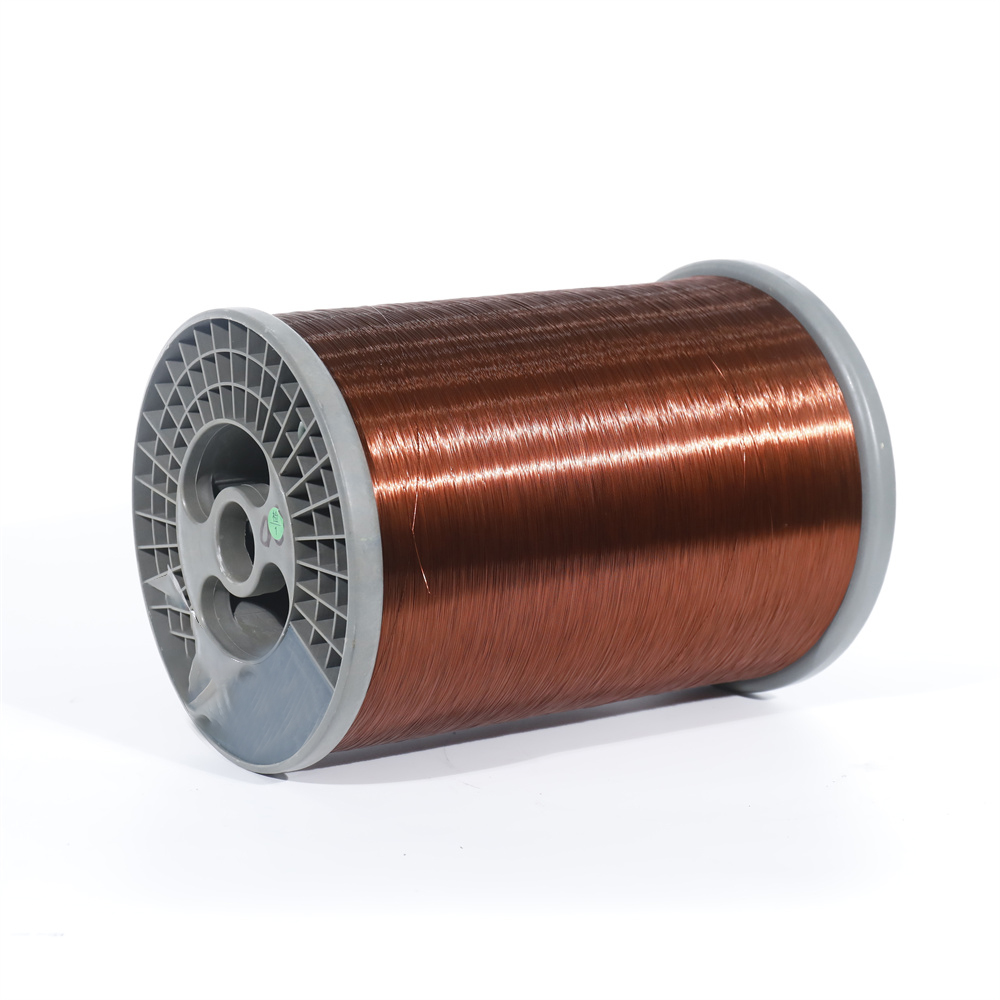
Selecting the correct thermal rating begins with calculating the absolute maximum internal temperature of the application. The formula is straightforward: Ambient Temperature + Temperature Rise (generated by copper losses and load) + Hot Spot Allowance. The hot spot allowance typically adds 10°C to 15°C to account for the innermost windings where heat dissipation is poorest.
Engineers must heavily factor in the physical enclosure. A fully enclosed, unventilated motor will retain significantly more heat than an open drip-proof (ODP) design. Liquid-cooled systems alter this dynamic, allowing for higher current densities while maintaining lower insulation temperatures. If a motor operates in a steel mill where the ambient air is already 60°C, the baseline calculation shifts entirely, forcing the use of Class H or Class N wire even for standard loads.
Continuous duty applications generate a stable, predictable thermal footprint. Intermittent duty applications, characterized by frequent start/stop cycles, introduce severe thermal cycling. Rapid thermal cycling causes the copper conductor and the polymer insulation to expand and contract at slightly different rates.
This mechanical stress demands insulation with exceptionally high heat shock resistance, regardless of the baseline continuous temperature. A motor operating at an average of 140°C but subjected to rapid thermal spikes may require a 180°C rated wire simply to survive the mechanical fatigue of expansion and contraction. Crane hoists and elevator motors frequently experience these rapid thermal spikes during heavy lifting phases.
The choice of thermal class directly dictates the physical properties of the coil. You must evaluate how the insulation interacts with the magnetic circuit and the manufacturing equipment.
Magnetic Field Strength & Space Factor: Higher thermal classes often require thicker insulation builds (Heavy or Triple build) to maintain dielectric strength under heat. Thicker insulation reduces the winding window fill factor. Less copper in the slot directly lowers the achievable magnetic field strength, requiring engineers to balance thermal survivability against magnetic efficiency.
Electrical Stress: Operating frequency impacts thermal degradation. High-frequency applications induce skin effect and proximity effect, pushing current to the surface of the conductor and generating localized heating. Breakdown voltage requirements must be evaluated at the maximum operating temperature, as dielectric strength decreases as heat increases. Variable Frequency Drives (VFDs) introduce high dV/dt voltage spikes that can degrade standard insulation rapidly.
Mechanical Stress: Aggressive automated winding processes exert immense tension on the wire. The need for insulation flexibility can sometimes override the desire for a higher thermal class. If a 200°C wire cracks during automated winding due to its stiffness, a highly flexible 180°C wire with a thicker build may provide superior field reliability.
Thermal Class | Typical Material | Heat Shock Resistance | Primary Trade-off | Stripping Method |
|---|---|---|---|---|
Class B (130°C) | Polyurethane | Low | Cannot withstand thermal overloads. | Direct Solder (360°C) |
Class F (155°C) | Modified Polyester | Moderate | Lacks resilience for heavy traction. | Mechanical / Chemical |
Class H (180°C) | Polyesterimide | High (≥200°C) | Requires higher winding tension. | Mechanical / High-Temp Solder |
Class N (200°C) | Polyamide-imide | Very High | Stiff film; prone to micro-cracking. | Mechanical / Laser |
Class R (220°C+) | Polyimide (Kapton) | Extreme | Highest cost; difficult to strip. | Mechanical / Laser |
Standard NEMA and IEC classifications cover the vast majority of industrial applications, but extreme edge cases require custom enameled wire. Standard classes fall short when engineers require hybrid properties that do not exist in off-the-shelf spools.
For example, voice coils and unsupported winding applications may require a 200°C thermal rating combined with a self-bonding overcoat to eliminate the need for varnish impregnation. Inverter-duty motors driven by VFDs experience severe voltage spikes that cause corona discharge. These applications demand custom corona-resistant insulation infused with inorganic nanoparticles, regardless of the base thermal class. Similarly, aerospace applications often require ultra-thin insulation builds on rectangular conductors to maximize magnetic field strength within strict weight and spatial constraints.
Deploying custom wire configurations introduces specific manufacturing risks. Supply chain delays are common, as bespoke runs require dedicated production time and specialized polymer mixing. Minimum order quantities are significantly higher than standard off-the-shelf spools. Furthermore, the long-term reliability of non-standard builds lacks the decades of historical field data associated with standard NEMA wires.
To mitigate these risks, engineering teams must mandate prototyping with standard classes first to establish a baseline of performance. Before committing to high-volume custom runs, verify the supplier's internal testing capabilities. Demand comprehensive documentation on dielectric loss, pinhole testing, and strict adherence to ASTM D1676 testing protocols to ensure the custom formulation performs exactly as modeled in your specific stator geometry.
Calculate the maximum internal hotspot temperature of your application and add a 15°C safety margin to determine the baseline thermal class.
Evaluate the mechanical stress of your automated winding equipment to ensure the chosen polymer film will not crack under tension or tight bending radii.
Determine stripping and termination requirements to avoid production bottlenecks with high-temperature polymers that cannot be solder-stripped.
Consult with your winding wire manufacturer to review application-specific heat shock and dielectric breakdown requirements before finalizing the Bill of Materials.
A: Exceeding the thermal class triggers rapid insulation degradation governed by the Arrhenius rule. For every 10°C the operating temperature rises above the rated limit, the insulation's expected service life is cut in half. This accelerated aging leads to embrittlement, dielectric breakdown, turn-to-turn short circuits, and eventual motor or transformer failure.
A: While thermally safer, substituting a higher class introduces mechanical and cost trade-offs. Higher-temperature films like Polyamide-imide are stiffer, which increases springback during winding and can reduce the space factor. Additionally, high-temp wires are more expensive and significantly harder to strip during termination.
A: The heat shock test evaluates the film's flexibility under thermal stress. The wire is tightly wound around a standardized mandrel to stretch the insulation. It is then baked in an oven at a temperature significantly higher than its class rating. If the insulation cracks under microscopic inspection, it fails the test.
A: The primary difference lies in material composition and thermal endurance. Class F typically uses Modified Polyurethane or Polyester, suitable for general industrial applications. Class H utilizes Polyesterimide, offering superior heat shock resistance and chemical stability, making it the standard for high-efficiency motors and hermetic compressors.
A: No. Thermal class only dictates the temperature at which the polymer insulation will survive for 20,000 hours. The ampacity is determined entirely by the cross-sectional area of the copper or aluminum conductor, not the temperature rating of the insulating film.
A: High-temperature polymers like Polyamide-imide (200°C) and Polyimide (220°C) cannot be solder-stripped because their melting points exceed standard soldering temperatures. They require mechanical abrasion, harsh chemical stripping agents, or precise laser ablation to expose the bare conductor for termination.


