
Please Choose Your Language
- All
- Product Name
- Product Keyword
- Product Model
- Product Summary
- Product Description
- Multi Field Search

Views: 0 Author: Site Editor Publish Time: 2026-11-25 Origin: Site


Premature coil failure in electrical motors and transformers rarely stems from a copper defect. It almost always traces back to insulation breakdown driven by thermal stress or mechanical damage during the winding process. Manufacturers face a constant trade-off on the shop floor. You want to maximize automated winding speeds and hit optimal slot fill factors. Yet, you must maintain dielectric integrity in high-vibration environments. Upgrading from single-layer enamels to a dual-layer composite solves this bottleneck. Specifically, polyester with a nylon overcoat provides a measurable reduction in friction and thermal degradation. It eliminates the primary failure points in modern coil manufacturing and ensures long-term reliability for heavy-duty applications. When winding heads pull wire at high speeds, standard enamels scrape and thin out. By switching to a composite insulation system, winding facilities drastically reduce scrap rates. The nylon layer acts as a physical shield, allowing the underlying polyester to function as a robust thermal and electrical barrier.
Thermal & Mechanical Synergy: Combines the high dielectric strength and thermal stability of a polyester base with the superior abrasion resistance and lubricity of a nylon topcoat.
Class 155 Compliance: Engineered to meet strict thermal requirements for continuous, reliable operation at 155°C (Class F).
Winding Efficiency: The nylon overcoat significantly lowers the coefficient of friction, enabling high-speed automated winding while virtually eliminating scrape-related insulation faults.
Termination Trade-offs: Unlike polyurethane wires, polyester nylon cannot be direct-soldered and requires mechanical or chemical stripping prior to termination.
Standard single-layer enamels often fail under the mechanical stress of modern manufacturing. Polyurethane and basic polyester coatings lack the surface toughness required for aggressive handling. During high-speed automated winding, the wire drags across tensioners, guide pins, and winding nozzles. This constant friction creates microscopic scrapes. When wires cross over each other inside a tight coil, the localized pressure forces these weakened spots to yield. The result is a turn-to-turn short circuit. Specifying reliable Magnet Wire for Electrical Coils requires addressing these mechanical vulnerabilities head-on.
Chemical exposure presents another significant risk. Single-layer wires remain highly susceptible to solvent crazing. When you apply aggressive secondary varnishes or encapsulation resins, the solvents attack the stressed areas of the enamel. Micro-cracks propagate through the insulation layer. Once the coil enters the curing oven, these cracks expand, exposing the bare copper. Environmental factors like moisture and industrial chemicals further degrade the compromised insulation, drastically reducing the motor's operational lifespan. Consider a high-speed stator winding line pushing 3,000 RPM. A standard polyester wire will shed microscopic dust particles as it runs through the ceramic eyelets. That dust is actually your insulation wearing away. By the time the wire reaches the slot, its dielectric rating has dropped significantly.
A dual-layer construction fundamentally changes how the wire behaves on the production floor. The modified polyester base layer serves as the primary electrical barrier. It delivers exceptional dielectric strength and thermal endurance. More importantly, it bonds fiercely to the copper conductor. This adhesion prevents the insulation from peeling back during tight-radius bends. The base layer handles the electrical load, but it relies on the topcoat for physical protection.
The extruded nylon topcoat acts as a sacrificial mechanical shield. Nylon possesses inherent lubricity, which drastically lowers the wire's coefficient of friction. It glides through tooling rather than scraping against it. This toughness resists the winding abuse that destroys single-layer alternatives. Using a Nylon Composite Enameled Copper Wire ensures the core insulation remains pristine from the spool to the final stator slot.
Manufacturers apply these enamels through a rigorous multi-pass process. The wire travels through coating dies and curing ovens up to 30 times. Each pass deposits a micro-layer of liquid enamel. This repetitive building process ensures perfect concentricity. It eliminates pinholes and creates a robust, uniform barrier. You get consistent electrical insulation that prevents winding short-circuits, even under heavy mechanical compression.
Layer | Material | Primary Function | Key Benefit |
|---|---|---|---|
Base Coat | Modified Polyester | Dielectric barrier, thermal stability | Prevents electrical shorts and handles heat |
Top Coat | Polyamide (Nylon) | Mechanical shield, friction reduction | Prevents scrape damage during high-speed winding |
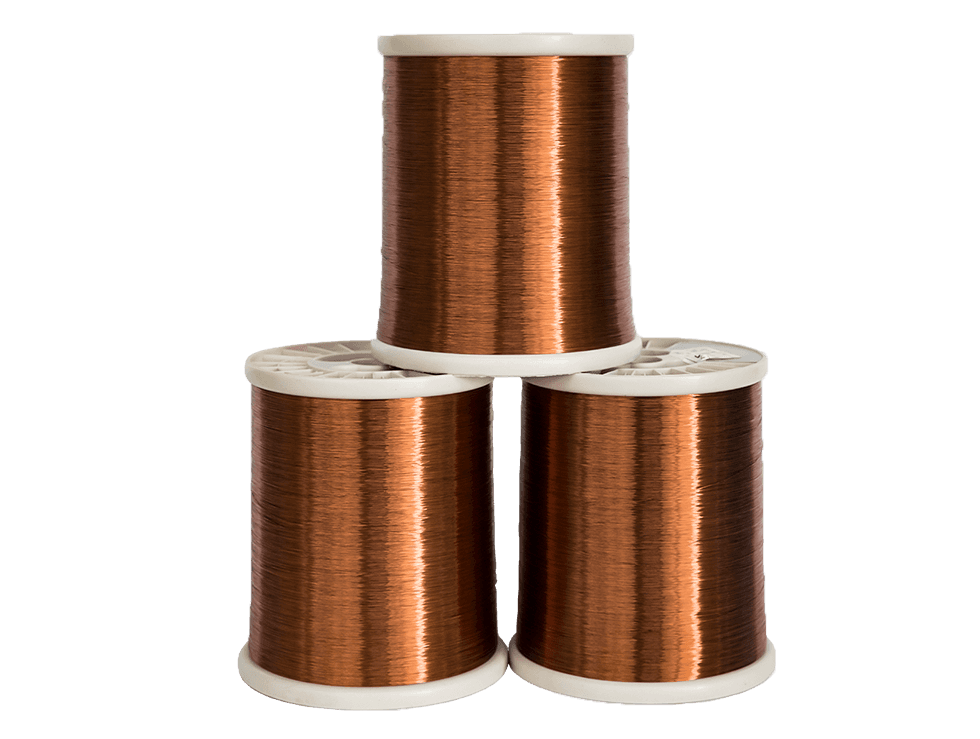
Thermal classification dictates the operational boundaries of your coil design. Class 155 (F) specifications guarantee the wire can operate continuously at 155°C for a minimum of 20,000 hours. The thermal life curve demonstrates predictable degradation, allowing engineers to calculate exact lifespan expectations under normal loads. This makes 155 Class Polyester Nylon Enameled Copper Wire highly reliable for standard industrial motors and transformers.
Motors rarely operate in perfect steady-state conditions. They face sudden thermal spikes during startup or rotor lock events. Heat shock resistance measures the enamel's ability to survive these rapid temperature increases without cracking. Cut-through resistance evaluates thermoplastic flow. When coils heat up, the insulation softens. Under the mechanical pressure of tightly wound crossovers, soft insulation can flow away, causing a short. The polyester-nylon composite resists this flow, maintaining physical separation between conductors even at elevated temperatures. In field testing, a locked rotor condition can spike internal coil temperatures past 200°C in seconds. A standard Class 130 wire will experience immediate thermoplastic flow, leading to a dead short. The nylon-polyester composite holds its physical structure long enough for thermal overload breakers to trip, saving the motor from total destruction.
Scrape resistance is the defining metric for winding survivability. Industry standards like NEMA MW 24-C and MW 28-C subject the wire to unidirectional and repeated scrape tests. A steel needle drags across the enamel under increasing weight until it breaches the copper. The nylon overcoat consistently yields scrape resistance values far exceeding those of plain polyester. This durability translates directly to fewer rejected coils on the factory floor.
The copper conductor itself plays a critical role in winding precision. You must use dead-soft annealed copper to prevent spring-back. If the copper retains too much temper, the wound coil will expand once released from the winding form. This expansion ruins dimensional tolerances. However, dead-soft copper is easily stretched. The tough nylon overcoat compensates for the underlying metal's inherent softness, protecting it from deformation during high-tension spooling.
Flexibility and adherence tests confirm the enamel's integrity. The wire is wrapped tightly around a mandrel matching its own diameter. The insulation must not crack or lose adhesion. This flexibility allows aggressive pin routing and tight-radius bends in compact stator designs. The dual-layer composite excels here, maintaining a flawless barrier even under severe mechanical distortion.
Dielectric breakdown voltage determines the maximum electrical stress the insulation can handle before failing. Consistency across the entire spool is mandatory. Manufacturers offer different insulation builds—Single, Heavy, and Triple. Heavy build provides a thicker enamel layer, offering higher breakdown thresholds for demanding applications. You must match the build thickness to the expected voltage spikes in your specific circuit design.
Adding a nylon layer marginally increases the overall outer diameter of the wire. This dimensional impact directly affects the motor slot fill factor. A thicker wire means you can fit fewer turns into a restricted stator slot. However, the nylon's lubricity allows the wires to pack more densely. They slide past each other and settle into tighter formations. This self-packing behavior often offsets the slight increase in diameter, resulting in an excellent overall slot fill efficiency. Winding technicians often notice that nylon-coated wire feels slicker during manual insertion. This slickness reduces the physical force required to push the final turns into a crowded stator slot. Less force means less chance of nicking the wire with an insertion tool.
Wire Enamel Type | Thermal Class | Solderability | Scrape Resistance | Primary Use Case |
|---|---|---|---|---|
Polyurethane | Class 130 / 155 | Direct-Solderable | Low to Moderate | Small electronics, relays, fast-cycle production |
Polyester Nylon | Class 155 | Requires Stripping | Excellent | Automotive coils, power tools, fractional HP motors |
Polyester-Imide | Class 180 / 200 | Requires Stripping | Very Good | High-temp industrial motors, heavy-duty transformers |
Polyimide | Class 240 | Requires Stripping | Outstanding | Aerospace, traction motors, extreme environments |
The choice between polyurethane and polyester nylon usually comes down to termination speed versus mechanical toughness. Polyurethane enamels melt away under soldering heat. This direct-solder capability eliminates the need to strip the wire, drastically speeding up production for small relays and contactors. However, polyurethane is mechanically fragile. It cannot survive the aggressive winding speeds used for larger motor stators.
Polyester nylon demands a dedicated stripping step before termination. You cannot solder through it. Despite this extra manufacturing step, the performance trade-offs heavily favor the composite wire for harsh applications. Specifying Polyester Nylon Magnet Wire gives you superior mechanical toughness and chemical resistance. It survives the winding process intact, ensuring the final product does not fail prematurely in the field. Think about a high-volume automotive alternator line. The winding machines pull wire so fast it blurs. Polyurethane would shred instantly in this environment. The extra three seconds it takes to mechanically strip the polyester nylon wire at the termination lugs is a necessary trade-off to achieve a zero-defect winding process.
Engineers frequently over-specify thermal classes, driving up material costs unnecessarily. If your application temperatures strictly remain below 155°C, upgrading to Class 180 Polyester-Imide or Class 200 Polyamide-imide provides no practical benefit. The cost-to-performance ratio of polyester nylon is highly optimized for standard industrial operating ranges. It delivers the necessary mechanical protection without the premium price tag of high-temperature aerospace-grade enamels.
Chemical compatibility also plays a role in this selection. Polyester nylon offers excellent resistance against modern, aggressive potting compounds and standard refrigerants. It performs exceptionally well in hermetic motor applications where the wire sits submerged in cooling fluids. High-temp enamels offer similar chemical resistance, but unless the thermal environment demands it, the nylon composite remains the most efficient engineering choice.
Switching to a nylon-coated wire requires immediate winding machine adjustments. The inherent lubricity of nylon means the wire slips through tensioners much easier than standard polyester. If you do not recalibrate the tensioning system, the machine will pull the wire too hard. This excessive tension elongates the copper conductor. Elongation increases the electrical resistance of the coil and generates excess heat during operation. You must dial back the tension to maximize the benefit of the slippery topcoat.
Payoff snags represent another common production bottleneck. The way the wire unspools dictates the stability of the winding process. You must match the spool type to your payoff speeds. Tapered spools allow for high-speed, over-the-end unspooling without snagging. Straight-flange spools work better for slower, rolling payoffs. Incorrect spool matching causes sudden tension spikes, which stretch the wire and damage the insulation layer. A practical tip for setup technicians: run a 100-foot dummy coil when switching to nylon composite wire. Measure the total resistance of the wound coil against the theoretical resistance of the raw wire. If the wound coil reads more than 2% higher, your tensioners are too tight and you are stretching the copper.
Because you cannot solder through polyester nylon, enamel removal methods become a critical production variable. Mechanical stripping remains the most common approach. High-speed rotary blades or fiberglass wheels physically grind the insulation away. Chemical stripping uses aggressive solvents to dissolve the enamel, leaving the copper untouched. Both methods require strict process control to ensure consistent termination quality.
Mechanical stripping introduces serious quality control risks. If the rotary blades are set too tight, they nick the copper conductor. A nick creates a stress riser. In high-vibration environments, this nick will eventually cause a fatigue failure, snapping the wire entirely. Furthermore, aggressive mechanical stripping can work-harden the copper, making it brittle. Operators must calibrate stripping equipment daily to remove the enamel cleanly without damaging the underlying metal.
Secondary insulation processes can inadvertently destroy the primary wire enamel. Solvent crazing prevention requires careful evaluation of chemical compatibility. The solvents used in many impregnating varnishes interact aggressively with stressed nylon. If the wire was stretched or bent sharply during winding, these areas become highly reactive to solvents.
To prevent crazing, you must establish strict curing cycle guidelines. Pre-heating the wound stator relieves mechanical stress in the enamel before applying the varnish. Controlling the ramp-up temperature in the curing oven ensures solvents evaporate safely before they can attack the nylon topcoat. Always run compatibility tests between your specific wire batch and your chosen potting compounds before full-scale production. If you use a dip-and-bake varnish process, monitor the viscosity of the resin tank daily. Thick, aging resin requires higher curing temperatures, which can push the nylon topcoat past its glass transition temperature prematurely. This causes the nylon to flow and thin out at the wire crossovers, reducing your turn-to-turn short protection.
The debate between copper and aluminum conductors centers on volumetric efficiency. Copper offers superior electrical conductivity. It carries more current in a smaller cross-sectional area. Aluminum is lighter and cheaper, but it requires significantly more space to achieve the same electrical performance. For space-constrained motor and transformer designs, copper remains the undisputed standard. Specifying high-quality Enameled Copper Winding Wire ensures you meet strict efficiency mandates without increasing the physical footprint of the device.
Profile selection dictates slot fill density. Standard round magnet wire is versatile and easy to wind. However, round wires leave empty voids between them when packed together. Flat or rectangular profiles eliminate these voids. They stack perfectly against each other, drastically increasing the slot fill factor and current-carrying capacity. Specify flat wire for high-density power transformers or EV traction motors, and stick to round wire for standard fractional horsepower applications.
Never accept wire shipments without comprehensive documentation. Procurement and engineering teams must mandate lot-specific testing reports. Relying on generic datasheets leads to unpredictable manufacturing failures. You need proof that the specific batch sitting on your floor meets all technical parameters.
Pinhole Testing: High-voltage continuity tests must show zero faults per 100 feet. Pinholes guarantee premature coil shorts.
Elongation Percentage: Verifies the copper is properly annealed and dead-soft. Low elongation means brittle wire that will spring back.
Dielectric Breakdown: Confirms the enamel thickness and curing quality meet the required voltage thresholds.
Scrape Abrasion: Validates the integrity and toughness of the nylon topcoat.
Conductor precision directly impacts thermal performance. Minor deviations in AWG or metric sizing change the overall coil resistance. If the copper diameter is slightly undersized, the resistance increases. The coil will run hotter than designed, degrading the insulation faster. Tight dimensional tolerances ensure predictable electrical performance across thousands of production units. When auditing a new supplier, measure the bare copper diameter and the overall outer diameter separately using a micrometer. A supplier might use undersized copper and apply extra enamel to meet the overall diameter spec. This cheat reduces the conductive cross-section, increasing the coil's resistance and causing the motor to run hot.
Packaging standards affect your factory floor efficiency. Evaluate spool capacities and winding formats carefully. High-volume production lines require large, continuous spools to minimize changeovers. Every time an operator stops the machine to swap a spool, you lose throughput. Ensure your supplier provides packaging that integrates seamlessly with your existing payoff equipment and tensioning racks. Choosing the right Polyester Nylon Enameled Copper Wire involves optimizing both the material properties and the delivery format.
To successfully integrate polyester nylon enameled copper wire into your production line and eliminate premature coil failures, execute the following steps:
Request sample spools from your supplier to test physical compatibility with your existing payoff racks and tensioning systems.
Review NEMA MW 24-C or IEC compliance datasheets to verify that the thermal and dielectric specifications align with your specific motor or transformer design.
Conduct pilot winding runs to recalibrate machine tension settings, ensuring you maximize the nylon's lubricity without elongating the copper conductor.
Audit your mechanical stripping tools and train operators to remove the dual-layer enamel cleanly without nicking or work-hardening the underlying copper.
A: It is rated as Class 155 (Class F). This means the wire is engineered to operate continuously at 155°C for a minimum of 20,000 hours without significant degradation of its electrical or mechanical properties.
A: No. Unlike polyurethane enamels, the polyester nylon composite does not melt away under soldering heat. You must mechanically or chemically strip the insulation from the copper conductor before making a solder or crimp termination.
A: The nylon overcoat acts as a sacrificial mechanical shield. It provides exceptional lubricity and scrape resistance, allowing the wire to survive high-speed automated winding without damaging the primary polyester dielectric layer underneath.
A: While the nylon layer slightly increases the wire's outer diameter, its inherent lubricity allows the wires to slide past each other and pack more densely. This self-packing behavior often offsets the size increase, maintaining an excellent slot fill factor.
A: Copper offers significantly higher electrical conductivity and volumetric efficiency than aluminum. It allows you to carry more current in a smaller space, making it essential for compact, space-constrained motor and transformer designs.
A: Scrape resistance is measured using industry standards like NEMA MW 24-C. A steel needle is dragged across the wire under increasing weight or repeatedly in the same spot until it breaches the enamel and makes electrical contact with the copper.


