
Please Choose Your Language
- All
- Product Name
- Product Keyword
- Product Model
- Product Summary
- Product Description
- Multi Field Search

Views: 0 Author: Site Editor Publish Time: 2026-11-21 Origin: Site


Selecting the correct conductor format is a strict engineering challenge. You cannot just pick a conductive metal and move on. You must balance spatial efficiency, thermal management, and specific insulation requirements. When evaluating Enameled Wire vs Copper Wire, you face a hard dividing line based on application physics.
Using standard insulated or bare copper wire in winding applications causes bulky components, thermal failure, and immediate short circuits. The thick jackets consume too much physical space. Conversely, using enameled wire for standard power transmission wastes specialized manufacturing resources and introduces severe mechanical fragility. The microscopic coating cannot survive physical impact or environmental exposure outside a protective housing.
This guide breaks down the structural, thermal, and application-specific differences between standard copper wire and enameled wire. We examine the physical properties, insulation mechanics, and operational limits of both formats to support accurate engineering and procurement decisions.
Insulation Profile: Standard copper wire relies on thick polymer jackets (like PVC) or remains completely bare, whereas enameled wire uses a microscopic layer of cured resin to prevent shorting while maximizing space.
Primary Application Split: Enameled wire (often called Copper Magnet Wire) is strictly engineered for creating electromagnetic fields (motors, transformers, inductors), while standard copper wire is designed for linear power transmission and grounding.
Thermal Tolerance: High-grade enameled wires, such as Polyester Enameled Copper Wire, offer superior high-temperature stability in confined spaces compared to standard wire insulation.
Material Variations: While standard wire is predominantly copper, enameled wire forces a secondary decision between Enameled Copper Wire (high conductivity, compact, durable) and Enameled Aluminum Wire (lower weight, highly affordable).
Form Factor: Enameled wire is available in both round and flat (rectangular) profiles to optimize the fill factor in specialized circuit and coil designs.
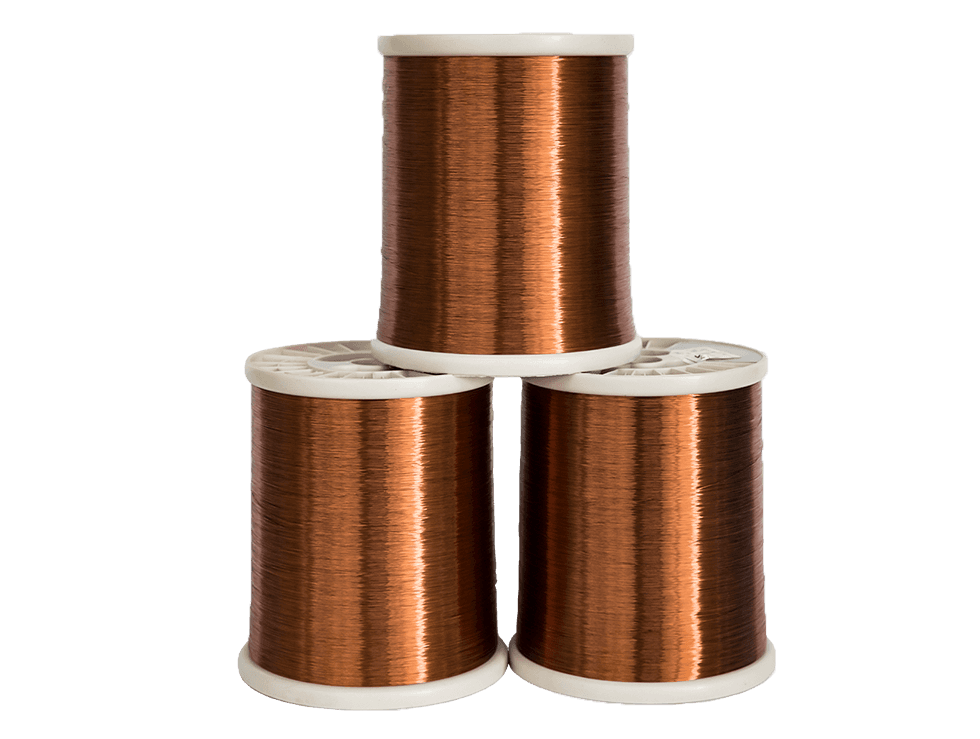
Before examining specialized winding conductors, we must identify the baseline requirements for general electrical connectivity, grounding, and power distribution. Standard copper wire serves as the default medium for moving current from a power source to an end device. It prioritizes mechanical protection and high-voltage isolation over spatial efficiency.
Standard copper wire comes in two primary physical structures: solid and stranded. Solid wire consists of a single, thick copper core, offering lower resistance and high rigidity. Stranded wire bundles multiple smaller copper strands together, providing flexibility for routing through conduits and moving machine parts.
Manufacturers apply standard insulation methods using extruded polymers. These jackets feature a high thickness-to-voltage ratio. A typical 120V or 240V building wire requires an insulation wall several millimeters thick to meet safety codes and prevent arcing.
Insulation Material | Typical Thickness | Primary Characteristics | Common Applications |
|---|---|---|---|
PVC (Polyvinyl Chloride) | 0.75mm - 1.5mm | Flexible, moisture-resistant, standard thermal rating | Residential wiring, low-voltage control panels |
THHN (Nylon-Coated) | 0.50mm - 1.0mm | High heat resistance, abrasion-resistant nylon jacket | Industrial conduit runs, commercial power distribution |
PTFE (Teflon) | 0.25mm - 0.75mm | Extreme chemical resistance, high temperature tolerance | Aerospace wiring, harsh chemical environments |
Bare wire represents a different category entirely. Bare copper wire is a conductor with absolutely zero insulation. It is raw metal exposed to the air. You must distinguish it entirely from enameled wire, which often appears bare to the naked eye but actually carries a highly engineered insulating film.
Bare copper serves strictly in grounding applications and uninsulated transmission lines. You use it to tie electrical panels to earth ground rods or as overhead transmission lines where the surrounding air acts as the primary insulator.
Standard insulated copper wire excels in specific environments. You route power through residential framing, connect industrial power grids, and link heavy machinery to breaker panels. The thick polymer jackets protect the copper core from moisture, chemical exposure, and physical abrasion during installation.
This robust protection introduces a severe limitation in electromagnetic design. Thick insulation drastically reduces the fill factor. The fill factor measures the amount of conductive material that actually fits into a specific cross-sectional area. When you wrap standard PVC wire around a steel core, the insulation consumes up to 50% of the available space. This makes standard wire entirely useless for compact coils, motors, or transformers where high magnetic density requires tightly packed conductors.
To solve the spatial limitations of standard wire, the industry developed specialized winding wires designed exclusively for electromagnetic applications. These conductors prioritize maximum copper density within the smallest possible volume.
Enameled wire discards thick extruded plastics in favor of a thin, continuous layer of synthetic varnish or enamel. Manufacturers apply liquid resins and cure them directly onto the metal through high-temperature baking ovens. This process repeats multiple times to build a uniform, pinhole-free dielectric barrier.
This microscopic layer prevents turn-to-turn short circuits in tightly wound coils without adding physical bulk. When you wind hundreds of turns of wire onto a bobbin, the adjacent wires physically touch. The enamel ensures electricity flows smoothly and efficiently through the entire intended path of the coil, rather than jumping across touching wires and bypassing the magnetic circuit.
You specify enameled wire in different structural shapes based on the required power density. Round wire remains the standard for most consumer electronics, small motors, and general-purpose transformers. It is easy to manufacture and winds smoothly on automated high-speed coil winding machines.
Flat magnet wire, also known as rectangular wire, serves advanced circuits and heavy-duty industrial applications. When you stack round wires, unavoidable geometric gaps remain between the circles. Flat magnet wire eliminates this dead space. The rectangular profile allows the conductors to stack flush against one another, maximizing the cross-sectional fill factor for high-density electromagnetic coils used in electric vehicle traction motors and utility-scale transformers.
While standard wire heavily favors copper, the winding wire sector offers distinct material choices based on weight constraints.
Enameled Copper Wire stands as the industry standard. It delivers the highest electrical conductivity, superior mechanical durability, and the best space factor. Copper's high tensile strength allows it to withstand aggressive winding tensions without stretching or breaking.
Enameled Aluminum Wire provides a specialized alternative. You select aluminum primarily for weight reduction in aerospace components or for significant weight reduction in large dry-type transformers. Aluminum weighs roughly one-third as much as copper.
You must calculate the trade-offs carefully. Aluminum lacks the tensile strength and high conductivity of copper. An aluminum coil must be physically larger than a copper coil to carry the same current. Furthermore, aluminum complicates termination processes, requiring specialized crimps or fluxes to break through its natural oxide layer during connection.
Comparing these two wire types requires evaluating them across critical engineering metrics. The physical and thermal behaviors dictate exactly where each wire type belongs in an electrical system.
Volumetric efficiency separates winding wire from transmission wire. Enameled wire allows for hundreds of tight turns in a small motor stator or transformer bobbin. The enamel coating typically measures only 10 to 50 micrometers thick. This allows the copper cores to sit practically metal-to-metal.
If you attempted to wind a 500-turn inductor using standard insulated copper wire, the resulting component would require a housing exponentially larger to accommodate the same number of turns. The magnetic field strength depends on the number of turns and the current. Pushing the conductors further apart with thick PVC insulation weakens the magnetic coupling and destroys the efficiency of the device.
Electromagnetic coils generate significant heat due to internal resistance. The insulation must survive continuous high temperatures without melting, cracking, or losing dielectric strength.
Standard PVC copper wire typically carries a thermal index of 60°C to 90°C. If confined in a tight space with continuous current, the PVC will soften, deform, and eventually fail, causing a catastrophic short to the conduit or adjacent wires.
Specialized enameled variants handle extreme heat. Polyester Enameled Copper Wire, often upgraded with polyamide-imide overcoats, can withstand continuous operating temperatures from 155°C up to 220°C+ in enclosed environments. This thermal stability allows motors to run hotter and harder without requiring massive cooling systems.
Wire Type | Typical Insulation Thickness | Maximum Operating Temperature | Primary Failure Mode in Coils |
|---|---|---|---|
Standard PVC Copper Wire | 1.0mm+ | 90°C | Insulation melting, massive volumetric waste |
Polyurethane Enameled Wire | 0.02mm - 0.05mm | 130°C - 155°C | Thermal degradation under heavy load |
Polyester-Imide Enameled Wire | 0.02mm - 0.05mm | 180°C - 220°C | Mechanical abrasion during winding |
Assuming both formats use oxygen-free, high-conductivity copper, the base metal performs identically. However, the physical format affects high-frequency AC applications and overall resistance.
Standard copper wire for power transmission often uses stranded configurations to maintain flexibility. Enameled wire almost exclusively uses solid conductors to maintain geometric precision during winding. In high-frequency applications, alternating current tends to travel along the outer surface of the conductor. You must carefully calculate the diameter of the solid enameled wire to ensure it does not introduce excessive AC resistance at higher operating frequencies.
Aligning wire specifications with end-use requirements prevents system failure. You cannot substitute one for the other without violating basic electrical engineering principles.
Enameled wire is the only viable choice for Motor Winding Wire, transformers, relays, and inductors. These devices rely on creating dense, concentrated magnetic fields. The wire must pack tightly into the slots of a steel stator or around a ferrite core.
These applications demand precise diameter tolerances. If the wire is slightly too thick, the required number of turns will not fit into the motor slot. The insulation must be entirely pinhole-free. Even a microscopic gap in the enamel will allow voltage to arc between adjacent turns, instantly destroying the motor's efficiency and leading to rapid burnout.
Standard insulated copper wire is mandatory for point-to-point power delivery. When routing power from a circuit breaker to an industrial lathe, the wire traverses open spaces, conduit pipes, and wall cavities.
Regulatory compliance requires robust mechanical protection that enamel simply cannot provide. The thick polymer jackets protect against moisture ingress, rodent damage, and accidental impact. Using enameled wire for structural wiring violates safety codes and creates a severe fire hazard, as the thin enamel would easily scratch against a conduit wall and short to ground.
Procuring the right wire involves balancing upfront material requirements with long-term manufacturing efficiency and reliability.
The manufacturing structure differs fundamentally between the two types. Standard copper wire relies on a relatively straightforward plastic extrusion process. Production speeds are exceptionally high, and the insulation applies in a single thick pass.
Enameled wire manufacturing includes a much more complex cycle. The multi-pass coating and curing process requires precise tension control, exact temperature profiling in the curing ovens, and continuous laser monitoring of the outer diameter. Applying 10 to 15 microscopic layers of liquid enamel and baking each layer perfectly adds significant processing time and overhead to the final spool.
When reviewing spec sheets for winding wire, you must verify specific industry standards. Look for NEMA MW 1000 or IEC 60317 compliance. These standards guarantee the wire meets strict tolerances for dimensions, adherence, and flexibility.
Pinhole Testing: Ensures the enamel layer has no microscopic gaps that could cause arcing.
Dielectric Breakdown Testing: Verifies the maximum voltage the insulation can withstand before failing.
Elongation and Adherence Testing: Confirms the enamel will not crack or flake off when the wire bends around tight corners in a stator slot.
Working with specialized winding wire introduces practical challenges on the production floor. You must handle the material correctly to maintain the integrity of the insulation.
The primary risk involves mechanical abrasion. The thin enamel coating is highly susceptible to scraping during automated or manual winding. If a wire guide, tensioner, or stator slot has a sharp edge, it will slice through the enamel and expose the bare copper.
To mitigate this, specify wires with high-abrasion-resistant overcoats, such as a nylon topcoat over a polyurethane base. You must ensure all winding machinery tensioners, pulleys, and eyelets are properly calibrated, polished, and free of burrs. Maintain strict tension limits to prevent stretching the copper, which thins out the enamel layer and reduces its dielectric strength.
Terminating enameled wire requires specific procedures. The enamel acts as a strict insulator and must be completely removed before making an electrical connection. If you attempt to solder directly over high-temperature enamel, the joint will fail or exhibit high resistance.
Mitigation depends on the thermal class of the wire. For low-temperature applications, choose solderable polyurethane enamels. These coatings act as a flux and melt away cleanly when exposed to a 360°C solder bath, allowing for rapid automated termination. For high-temperature polyester or polyimide wires, the enamel will not melt. You must implement mechanical stripping using rotary wire strippers or chemical stripping protocols to expose the bare copper before soldering or crimping.
The choice between enameled wire and standard copper wire is dictated entirely by the application physics. Electromagnetic field generation requires the microscopic insulation and high packing density of enameled wire. Linear power transmission requires the robust mechanical and environmental protection of standard insulated copper wire.
Use this shortlisting logic for your next project: If you are building a motor, transformer, relay, or custom coil, specify Copper Magnet Wire based on your calculated thermal class and spatial limits. If you are wiring a chassis, connecting facility equipment, or establishing a ground plane, specify standard jacketed copper.
Take the following steps to finalize your material selection:
Audit your spatial constraints to determine the exact required fill factor for your bobbin or stator slots.
Calculate the maximum continuous operating temperature of your device to select the correct thermal class rating.
Evaluate your production floor's termination equipment to choose between solderable enamel or mechanically stripped high-temperature enamel.
Request physical samples and dielectric test reports from certified wire manufacturers to verify NEMA or IEC compliance before finalizing your bill of materials.
A: Yes, "magnet wire" is the standard industry term for enameled wire used specifically to create electromagnetic fields. While the term includes the word "magnet," the wire itself is not magnetic. It can be manufactured using either a copper or an aluminum conductor core.
A: Bare wire is a raw metal conductor without any insulation whatsoever. Enameled wire is coated with a thin, nearly invisible layer of cured resin insulation. This microscopic coating allows the wire to be tightly wound into coils without the adjacent turns short-circuiting against each other.
A: No. Bare copper wire completely lacks insulation. If you wind it into a coil, the touching turns will immediately short-circuit. The electrical current will take the path of least resistance straight through the touching metals, bypassing the coil structure entirely and failing to generate a magnetic field.
A: Flat magnet wire features a rectangular cross-section rather than a traditional round one. Engineers use it in specialized circuits and high-performance coils to eliminate the empty geometric space that naturally occurs between stacked round wires. This maximizes the fill factor, power density, and overall efficiency.
A: Removal methods depend entirely on the specific enamel chemistry. Polyurethane coatings can be burned off directly in a high-temperature solder bath. High-temperature coatings like polyester or polyimide must be scraped off mechanically using rotary tools or removed using specialized industrial chemical strippers.
A: It is not better regarding electrical conductivity or space efficiency. However, it is significantly lighter and much more affordable than copper. This makes enameled aluminum wire ideal for weight-sensitive applications like aerospace components or large transformers where physical space is not strictly limited.


