


Specifying the wrong winding wire does not just reduce system efficiency. It causes catastrophic electrical shorts and massive hardware failures. Engineers see this frequently in densely packed motors, high-frequency transformers, and sensitive relays. We define enameled wire (often called magnet wire) as a conductive core coated by an extremely thin, highly resilient polymer film. This advanced insulation replaces bulky plastic sheaths entirely. It allows you to wind coils incredibly tight without risking dangerous cross-layer arcing.
Choosing the right specification requires you to balance several critical factors. You must weigh strict thermal limits, conductor material properties, physical form factors, and tight manufacturing tolerances. A slight miscalculation in your insulation build can easily ruin a motor's fill factor. This guide provides the foundational technical baseline and vital procurement criteria. You will learn how to evaluate material trade-offs, decode complex thermal classifications, and confidently vet suppliers for your next high-stakes project.
Enameled wire utilizes 1 to 4 multi-layered polymer coatings (not traditional paint) to prevent short circuits in tightly coiled applications.
Choosing between Enameled Copper Wire and Enameled Aluminium Wire hinges on weight limits vs. spatial constraints (aluminum requires a 1.6x larger cross-section for equivalent conductivity).
Insulation classes dictate application: Polyurethane (PUR) allows direct soldering at 375°C, while Polyimide (PAI) withstands harsh 240°C+ environments.
Partnering with a strict-tolerance supplier prevents latent defects like micro-cracking, inconsistent tension, and variable electrical resistance.
The primary job of the core conductor is maximizing electrical current flow while minimizing inherent resistance. Standard bare wire relies entirely on surrounding air for insulation. Air requires physical space. You cannot use bare conductors for compact coil winding because adjacent loops would touch and immediately short-circuit. Applying a micro-thin polymer coating solves this spatial problem completely.
The industry standard for electromagnetic applications remains Enameled Copper Wire. Copper delivers superior electrical conductivity and exceptional tensile strength. Manufacturers can draw highly annealed electrolytic copper down to micro-diameters safely. Modern facilities routinely produce copper strands as thin as 8 microns. To put this in perspective, this falls well below the thickness of a human hair. Copper resists stretching during high-speed automated winding processes, which keeps your internal resistance values perfectly stable.
However, specific engineering scenarios demand Enameled Aluminium Wire. Aluminum provides a highly cost-effective and incredibly lightweight alternative. Aerospace components, drone motors, and large-scale utility transformers often utilize aluminum to strip away excess mass. You must explicitly account for the primary trade-off during the design phase. Aluminum possesses lower conductivity than copper. It demands a 1.6 times larger cross-sectional area to achieve the exact same direct current (DC) resistance.
Engineers typically rely on a straightforward decision matrix to shortlist core materials. You weigh absolute weight constraints against absolute space constraints. If your design limits mass above all else, favor aluminum. If your design demands maximum power density within a tiny physical footprint, favor copper.
Conductor Material |
Primary Advantage |
Primary Limitation |
Ideal Application Use Case |
|---|---|---|---|
Copper |
Maximum conductivity per square millimeter |
Higher weight and higher raw material cost |
Compact EV traction motors, micro-transformers |
Aluminum |
Up to 50% lighter than equivalent copper coils |
Requires 1.6x more physical volume for same power |
Aerospace actuators, large industrial microwave coils |
We must clarify a common industry misunderstanding. The term "enamel" refers to highly advanced polymer resins, not standard decorative paint. These chemical barriers endure immense mechanical stress, chemical exposure, and intense heat over a standard 20,000-hour operational baseline.
Manufacturers classify these polymer resins according to strict NEMA (National Electrical Manufacturers Association) and IEC (International Electrotechnical Commission) thermal standards. Selecting the wrong temperature class guarantees premature insulation degradation and catastrophic coil failure.
Polyurethane (PUR) - Rated up to 155°C: This chemistry offers unique "heat-strippable" flux properties. You can apply a soldering iron directly to the wire. The coating melts cleanly away without carbonizing. This allows for rapid, non-destructive soldering in small transformers, relays, and consumer electronics.
Polyester & Polyesterimide (PEI) - Rated up to 180°C/200°C: This serves as the versatile workhorse for the broader electrical industry. It manages moderate thermal stress effortlessly. You will find PEI coatings in standard industrial motors, generators, and commercial HVAC compressors.
Polyamide-imide (PAI) - Rated up to 240°C: Engineers specify PAI for high-performance extreme environments. It withstands aggressive chemical solvents, severe mechanical abrasion, and intense heat. Aerospace systems and heavy traction motors rely heavily on PAI insulation to survive harsh operating conditions.
Beyond the chemical type, you must also specify the insulation build thickness. Manufacturers offer Single Build and Heavy Build options. Single Build prioritizes extreme compactness and low weight. It works best for low-voltage systems safely isolated from sudden power spikes. Heavy Build provides nearly double the polymer thickness. It prioritizes maximum dielectric strength. You should select Heavy Build when your system faces high risks of thermal shock, harsh vibration, or severe voltage transients.
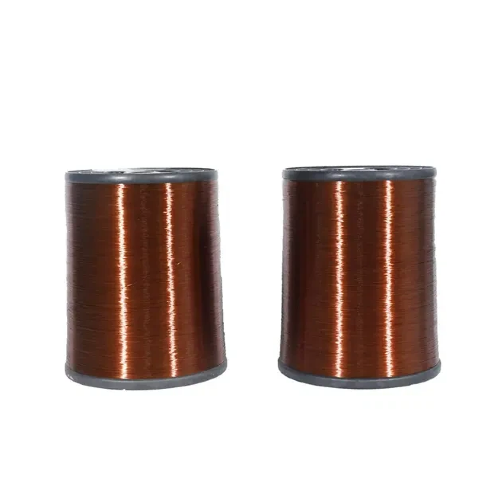
The physical shape of the conductor impacts overall motor efficiency just as heavily as the material itself. You typically choose between standard round profiles and engineered rectangular profiles.
Round enameled wire represents the default standard for general winding operations. Manufacturers produce round profiles quickly and affordably. Round strands route easily through complex stator slots. However, packing round circles together inherently creates tiny air gaps. These gaps represent wasted space. You simply cannot eliminate the voids between adjacent round wires inside a tight coil.
Rectangular (flat) enameled wire serves as the premium solution for high-density modern applications. Automotive engineers use flat wires extensively in electric vehicle (EV) traction motors to push performance boundaries.
The efficiency outcome becomes obvious when you examine the cross-section. Flat wires pack tightly together like bricks in a wall. This physical geometry eliminates the wasted air gaps. It maximizes the "copper fill factor" within the confined motor casing. A higher fill factor directly translates to higher continuous power output. You achieve greater torque and efficiency without increasing the physical footprint of the hardware.
Chart: Estimated Slot Fill Factor by Form Factor
Wire Profile Shape |
Typical Slot Fill Factor (%) |
Wasted Space Impact |
Efficiency Gain Potential |
|---|---|---|---|
Standard Round |
40% - 45% |
High (Large Air Gaps) |
Baseline (0%) |
Compacted Round |
45% - 55% |
Moderate |
Moderate (Up to 5%) |
Rectangular / Flat |
70% - 85% |
Minimal (Brick-like stacking) |
High (15%+ Power Density Gain) |
We must warn buyers about the hidden dangers of subpar manufacturing tolerances. Sourcing cheap wire often leads to catastrophic failure in the field. The drawing process dictates the internal integrity of the conductor. If a manufacturer uses inconsistent tension during the wire-drawing phase, the copper physically stretches. This stretching reduces the wire diameter slightly and fundamentally alters its target resistance value. Your perfectly designed coil will suddenly run much hotter than expected.
Insulation application methodology requires equal scrutiny. High-grade polymer insulation is never applied in a single, thick, sloppy coat. Top-tier factories apply the resin in multiple micro-thin layers. Advanced facilities sometimes apply up to 30 individual curing passes.
Pinhole Prevention: Multi-layering ensures any microscopic defect in one layer gets immediately covered by the next.
Mechanical Flexibility: Thin stacked layers bend gracefully around sharp stator corners without fracturing.
Dielectric Consistency: Gradual build-up ensures a perfectly uniform electrical barrier across the entire spool.
Modern engineering also introduces advanced application risks. High-voltage variable frequency drives (VFDs) push standard insulation to its breaking point. VFDs generate rapid voltage spikes that trigger a phenomenon known as corona discharge. This partial electrical discharge ionizes trapped air pockets, creating ozone. The ozone rapidly attacks and degrades standard polymer resins. You must specify specialized nano-tech primers and corona-resistant topcoats to prevent rapid insulation breakdown in these aggressive high-frequency environments.
Your engineering limits only matter if your supply chain can actually deliver them consistently. Vetting a reliable vendor requires moving beyond basic specification sheets. You must audit their internal testing rigor and logistical handling procedures.
First, demand strict verification of standards. A reliable vendor must demonstrate unwavering adherence to international frameworks like IEC, NEMA, or JIS. They should willingly provide transparent documentation highlighting batch-specific breakdown voltage testing. If they hesitate to share internal audit results, you should look elsewhere.
Process transparency separates exceptional vendors from average ones. Ask detailed questions about their shop floor. Look for manufacturers utilizing inline laser diameter monitoring. These laser systems measure the wire continuously during production, detecting micron-level deviations instantly. They must also utilize automated tension control winding systems to guarantee spool-to-spool consistency.
Do not ignore handling and logistics. Poor packaging or rough warehouse handling accounts for significant defect rates. Scratches sustained during transit will silently compromise the dielectric barrier. A great plated wires supplier provides strict guidelines on proper storage. They ensure climate-controlled warehousing and design packaging that avoids abrasive contact entirely. Strict handling protocols preserve the delicate polymer integrity. Data shows these practices reduce accidental field failures by up to 30%.
Before committing to high-volume procurement, always demand next steps for localized verification. Request sample spools. Run these samples through your own aggressive chemical resistance baths and thermal shock chambers. This final localized testing ensures the theoretical specifications match your real-world manufacturing realities.
Specifying the optimal winding wire requires a highly precise alignment between thermal class, core conductor material, and spatial limitations. You cannot simply grab a spool off the shelf and hope it survives the rigors of an industrial motor or an aerospace actuator. The multi-layered polymer resins and drawn metallic cores demand careful engineering foresight.
We strongly advise engineering and purchasing teams to look well beyond the raw price-per-kilo. You must evaluate the complete operational reliability of the product. Factor in the value of drastically reduced failure rates, the efficiency leaps gained from higher fill factors, and the peace of mind provided by strict quality assurance processes. Selecting a high-tolerance partner directly safeguards your final hardware, ensuring maximum longevity and uncompromised electrical performance.
A: They are industry synonyms. Both terms refer to a conductive metallic core (typically copper or aluminum) coated in a micro-thin, polymer-based electrical insulation. Engineers use both extensively for creating precise electromagnetic fields in motors, transformers, and intricate coil windings.
A: No. The color (whether red, green, or amber) is merely a cosmetic dye. Manufacturers add it to specific polymer types solely for visual identification on the factory floor. The color has absolutely no bearing on thermal resistance, breakdown voltage capacity, or the underlying wire gauge.
A: Low-temperature thermal ratings (like PUR) are "heat-strippable" and melt away cleanly under the direct heat of a soldering iron. High-temperature insulation classes (like PAI) resist heat intensely. They require deliberate mechanical scraping, specialized chemical solvent baths, or abrasive rotary stripping tools to expose the bare conductor.


