
Please Choose Your Language
- All
- Product Name
- Product Keyword
- Product Model
- Product Summary
- Product Description
- Multi Field Search

Views: 0 Author: Site Editor Publish Time: 2025-12-09 Origin: Site


In the manufacturing of motors, transformers, and electromagnets, the winding wire is often the single most critical component. A microscopic defect in the insulation of an enamel-insulated wire (magnet wire) can lead to inter-turn short circuits, overheating, and ultimately, the catastrophic failure of the entire device.
For procurement managers and quality engineers, knowing how wire is tested is just as important as knowing the specifications.
This guide breaks down the rigorous quality inspection process into five essential categories, explaining not just what we test, but why it matters for your production line.
Before any high-tech equipment is used, the wire must pass a fundamental physical examination. If the dimensions are wrong, the wire simply won't fit into your motor slots.
The surface of the wire must be smooth and uniform. Inspectors look for:
Oxidation: Dark spots indicating the copper/aluminum conductor was exposed.
Bubbles/Particles: Dust trapped under the enamel, which creates weak points.
Shadowing: Uneven application of the enamel varnish.
Using laser micrometers, we measure two critical values:
Conductor Diameter: This determines the resistance. If it's too thin, resistance increases, and the motor overheats.
Overall Diameter (with Enamel): This ensures the wire fits into the core slots.
Ovality (Out-of-Roundness): The wire must be perfectly round. If the wire is oval, it may twist during high-speed winding, causing the enamel to crack.
Modern automatic winding machines are brutal. They pull, bend, and twist wire at high speeds. Mechanical testing ensures the wire can survive this process without the insulation peeling off.
We stretch the wire until it breaks.
Why it matters: This tests the softness of the conductor. If the wire is too brittle (low elongation), it will snap when your winding machine applies tension. Aluminum wire, in particular, requires careful monitoring of elongation to prevent breakage.
The wire is wound around a mandrel and then released. We measure how much it "springs back" or uncoils.
Why it matters: You want low springback. If the wire is too "springy," your coils will not stay tight, leading to loose windings and vibration issues in the final motor.
The wire is suddenly stretched or wound around a rod with a diameter close to its own.
Pass Criteria: The enamel coating must not crack or lose adhesion to the conductor. It should stretch with the copper/aluminum like a second skin.
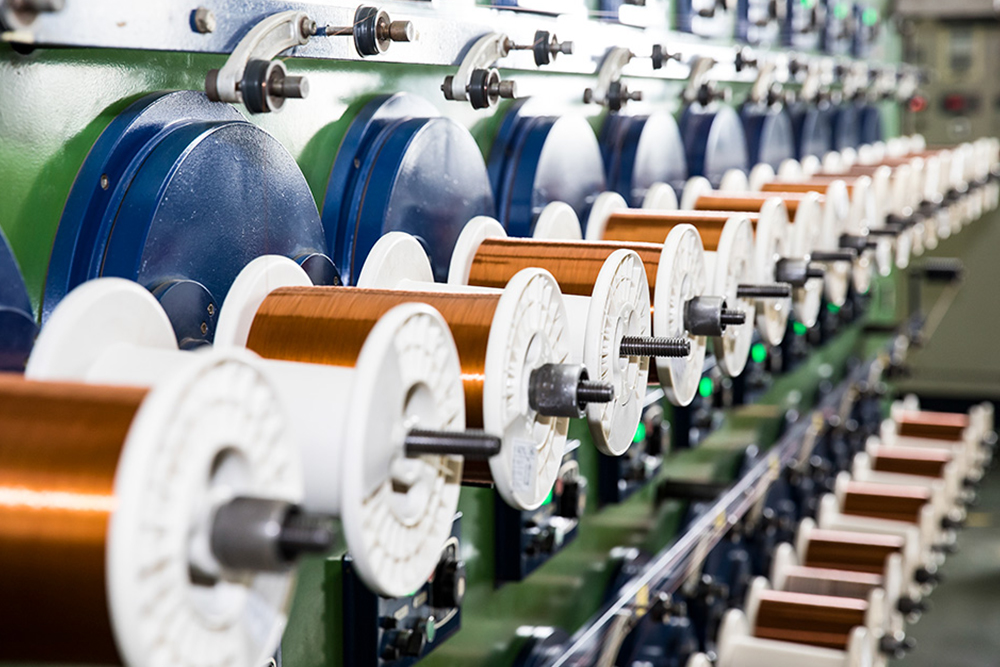
This is the most critical category for safety and reliability.
Two pieces of wire are twisted together (Twisted Pair method), and voltage is applied until the insulation fails.
Why it matters: A standard motor might run at 220V, but voltage spikes can occur. High-quality enamel wire might withstand 5000V+ before failing, providing a massive safety margin against surges.
A long length of wire (e.g., 30 meters) is passed through a saltwater bath or a high-voltage scanner.
Why it matters: This detects microscopic holes in the insulation that the naked eye cannot see.
Standard: For high-quality wire, the standard is often zero pinholes per tested length. Any pinhole is a potential short circuit waiting to happen.
Motors generate heat. The "Thermal Class" of a wire (e.g., 155°C, 180°C, 200°C) is determined by these tests.
The wire is wound into a coil and placed in an oven at a temperature significantly higher than its rating (e.g., 200°C) for 30 minutes.
Why it matters: Rapid heating causes the copper to expand. If the enamel is brittle, it will crack under this expansion. A passing wire shows no cracks after cooling.
Two crossed wires are placed under a load (pressure) and heated. We record the temperature at which the insulation softens enough for the wires to touch and short out.
Why it matters: This simulates a stalled motor scenario where the windings get extremely hot while being pressed together.
Motors are rarely used in sterile environments. They are exposed to varnishes, oils, and refrigerants.
The wire is immersed in standard solvents (like alcohol, xylene, or benzene) and then scratched with a standard pencil hardness test.
Why it matters: After you wind a motor, you often dip it in impregnating varnish. If the wire's enamel dissolves or softens in that varnish, the motor is ruined before it ever runs.
Quality inspection of enamel-insulated wire is not just a formality; it is the guarantee of your product's reputation. A comprehensive inspection covering dimensions, mechanics, electricity, heat, and chemistry ensures that the wire you buy will perform flawlessly in the field.
When sourcing magnet wire, always ask your supplier for a Technical Data Sheet (TDS) and a test report that covers these five critical areas.


