
Please Choose Your Language
- All
- Product Name
- Product Keyword
- Product Model
- Product Summary
- Product Description
- Multi Field Search

Views: 0 Author: Site Editor Publish Time: 2026-11-18 Origin: Site


High-performance electrical equipment relies entirely on the thermal stability, dielectric strength, and mechanical durability of its internal winding components. Selecting an incorrect insulation class or sub-standard wire specification leads to premature motor failure, thermal breakdown under load, and costly manufacturing defects during high-speed automated winding. Engineers and production managers cannot afford to compromise on the foundational materials that dictate the operational lifespan of their products.
This guide breaks down the technical properties, application suitability, and strict procurement criteria for Polyester Enameled Copper Wire. By understanding the exact chemical and physical thresholds of this insulation type, you can eliminate guesswork from your material selection process. We provide engineering and procurement teams with the framework needed to evaluate suppliers, mitigate manufacturing risks, and ensure reliable integration into OEM manufacturing lines.
Thermal Baseline: 130 Class Polyester Enameled Copper Wire provides a highly reliable, cost-effective standard for continuous operation at 130°C (Class B), balancing thermal endurance with manufacturing economy.
Mechanical Durability: High adhesion, flexibility metrics, and strict visual appearance standards make this wire highly suitable for rigorous, high-speed automated winding processes without risking enamel micro-cracking.
Application Scope: Serves as the industry-standard choice for fractional horsepower motors, low-voltage transformers, general-purpose inductors, speaker voice coils, and electromagnetic actuators.
Sourcing Imperatives: Selecting a reliable Enameled Copper Wire Supplier requires rigorous auditing of their adherence to IEC/NEMA standards, pinhole testing protocols, and batch-to-batch dimensional consistency.
Engineers must match the chemical and physical properties of the insulation to the specific environmental and operational stresses of the end product. Failing to align the insulation characteristics with the operational environment results in catastrophic short circuits and compromised equipment integrity.
The foundation of polyester magnet wire lies in the synthesis of heat-cured polyester resins. These resins, typically based on terephthalate chemistry, provide a robust cross-linked polymer matrix once cured. This chemical structure delivers excellent mechanical toughness and resistance to standard industrial solvents. The cross-linking density directly correlates to the wire's ability to resist abrasion during the winding process.
Manufacturing this wire requires a highly controlled, multi-pass dip-and-bake enameling process. Bare copper wire is first drawn to the precise diameter and annealed to ensure maximum ductility. The wire then passes through an enamel applicator and into a curing oven. The curing ovens operate at specific temperature gradients, often ramping from 300°C at the entry to over 500°C at the exit. This process is repeated multiple times—often between 10 to 20 passes depending on the required insulation thickness. Multiple thin layers cure more uniformly than a single thick layer. This eliminates trapped solvent bubbles and guarantees consistent dielectric strength across the entire spool.
When designing stators or bobbins, engineers must choose between round and rectangular wire profiles. Enameled Copper Round Wire remains the dominant form factor for standard motor stators and small transformer bobbins due to its handling characteristics. Round wire feeds smoothly through the complex routing nozzles of automated winding machines without twisting or snagging.
While rectangular or flat wire offers a superior spatial efficiency by eliminating the empty voids between round conductors, it is significantly more difficult to wind. Rectangular wire requires specialized equipment to prevent edge damage and insulation cracking at sharp 90-degree bends. For the vast majority of fractional horsepower motors and general-purpose inductors, round wire provides the optimal balance of manufacturing speed, cost efficiency, and acceptable slot fill.
Profile Type | Typical Slot Fill Factor | Winding Speed Capability | Tooling Complexity | Primary Use Case |
|---|---|---|---|---|
Round Wire | 70% - 78% | Very High | Low | Fractional HP motors, standard bobbins |
Rectangular Wire | 85% - 92% | Low to Medium | High | EV traction motors, large power transformers |
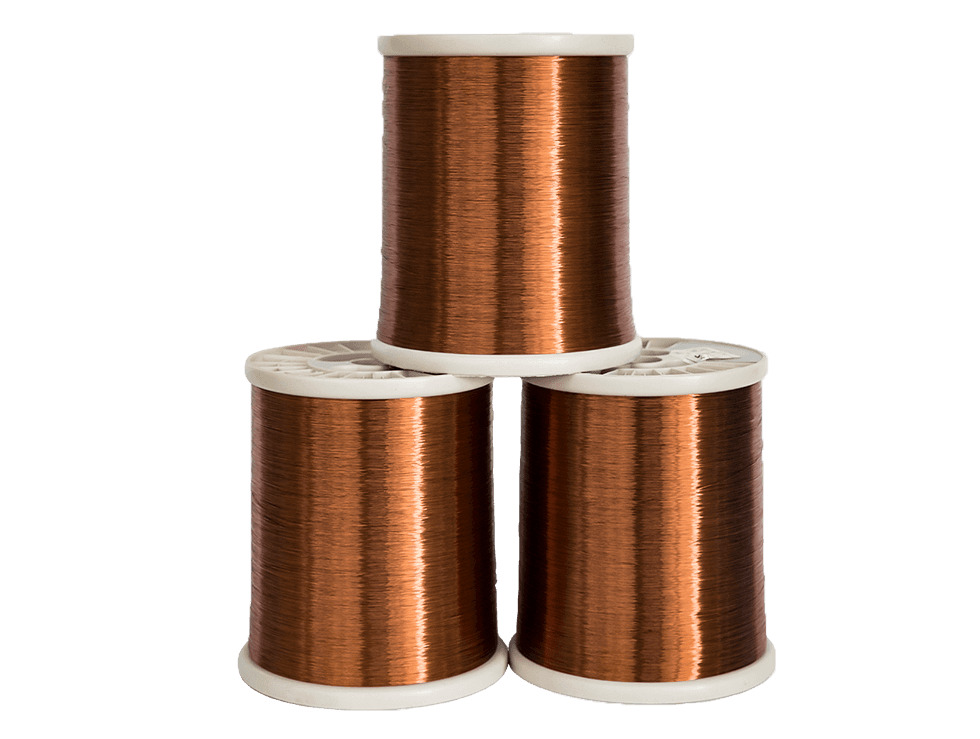
Defining the exact physical and electrical thresholds required to meet operational success criteria prevents over-engineering and controls material costs. Every batch of wire must be evaluated against strict dimensional and performance standards.
Thermal classification dictates the maximum temperature at which the wire can operate continuously for a standard lifespan (typically 20,000 hours) without insulation degradation. 130 Class Polyester Enameled Copper Wire carries a 130°C (Class B) thermal rating. This makes it highly suitable for continuous load operation in standard industrial and consumer environments.
Beyond continuous operation, engineers must account for thermal shock resistance and the cut-through temperature. Cut-through temperature is the point at which the insulation softens enough under physical pressure to allow two intersecting wires to short circuit. Polyester enamel exhibits strong resistance to thermoplastic flow. Standard NEMA MW 5-C testing requires Class 130 wire to withstand cut-through pressures at temperatures exceeding 175°C. This maintains physical separation between conductors even during temporary peak load spikes that push internal coil temperatures above the 130°C baseline.
Mechanical durability is critical during the winding process. Baseline visual inspection criteria dictate that the wire surface must be perfectly smooth, exhibit a shiny metallic color, and be entirely free of scratches, blisters, or abrasions prior to winding. Any surface defect acts as a stress concentration point that will fail under tension.
Flexibility and adhesion are tested rigorously on the shop floor. The wire must withstand sharp bending radii without the enamel delaminating. Quality assurance teams perform mandrel wrap tests, wrapping the wire around a cylinder 1x to 3x its own diameter. The enamel must not crack. During high-tension automated winding, the wire is pulled through ceramic eyelets and tensioners. Superior surface smoothness and scratch resistance ensure the insulation remains intact, preventing turn-to-turn shorts in the finished coil.
Dielectric strength measures the insulation's ability to withstand electrical voltage without breaking down. This metric is heavily dependent on the insulation build thickness. Industry standards categorize thickness into Grade 1 (Single), Grade 2 (Heavy), and Grade 3 (Triple) builds. A heavier build provides a higher breakdown voltage, essential for applications subjected to voltage spikes or harsh operating conditions.
Concentricity—the uniform distribution of the enamel around the copper core—is just as critical as overall thickness. If the enamel is applied unevenly, thin spots become vulnerable to dielectric breakdown. High concentricity ensures consistent insulation thickness, drastically reducing the risk of turn-to-turn short circuits within tightly packed coils.
AWG Size Range | Grade 1 Minimum Breakdown (Volts) | Grade 2 Minimum Breakdown (Volts) |
|---|---|---|
10 - 14 AWG | 3000V | 5000V |
15 - 24 AWG | 2500V | 4500V |
25 - 30 AWG | 2000V | 4000V |
Once wound, coils are frequently subjected to secondary processing, such as vacuum pressure impregnation (VPI) with varnishes or encapsulation in epoxy resins. The polyester enamel must resist chemical attack from the solvents present in these secondary compounds. Standard polyester enamel demonstrates excellent chemical resistance against xylene, toluene, and naphtha. This ensures the primary insulation does not soften, swell, or dissolve during the curing of secondary varnishes.
Mapping technical properties to specific manufacturing use cases ensures that the selected wire delivers reliable performance in the field. Polyester Insulated Magnet Wire is utilized across a broad spectrum of electromagnetic devices.
In the electric motor industry, Copper Winding Wire for Motors is a foundational component. Polyester enameled wire is the standard choice for fractional horsepower motors, household appliance motors, and general-purpose industrial drives operating in controlled environments.
Motor design requires a careful balance between wire gauge, slot fill factor, and motor efficiency. Thicker wire reduces electrical resistance and I2R losses, improving efficiency, but takes up more physical space in the stator slot. The thin yet robust nature of polyester insulation allows motor designers to optimize the slot fill factor, packing more copper into the stator without compromising dielectric safety.
Polyester enameled wire sees extensive use in low-to-medium voltage dry-type transformers and power supply inductors. In these applications, the wire is wound into primary and secondary coils. The insulation must withstand the voltage differential between adjacent turns and layers.
The high dielectric strength of polyester insulation minimizes the risk of internal arcing. Furthermore, the precise dimensional tolerances of high-quality round wire help maintain tight, uniform winding layers. This uniformity is necessary for minimizing eddy current losses, maintaining magnetic field stability, and ensuring the transformer operates within its designed thermal limits.
Precision electromagnetic devices rely on fine-gauge polyester enameled wire. Acoustic equipment, specifically speaker voice coils, requires wire that is extremely lightweight yet capable of handling rapid thermal cycling and intense mechanical vibration. The strong adhesion of polyester enamel prevents the insulation from flaking off during high-frequency oscillation.
Similarly, hard disk drive head actuators and electromagnetic relays require fine-gauge wire wound with extreme precision. The smooth surface finish of polyester wire allows for flawless layer winding in these miniature components, ensuring rapid, reliable electromagnetic response without adding unnecessary bulk or weight.
Selecting the right wire involves conceptual trade-offs between cost, thermal rating, and manufacturing efficiency. Understanding how polyester compares to alternative enamels prevents costly over-specification or dangerous under-specification.
Insulation Type | Thermal Class | Solderability | Primary Advantage | Typical Application |
|---|---|---|---|---|
Polyester | 130°C (Class B) | Requires Stripping | High mechanical strength, cost-effective | General motors, standard transformers |
Polyurethane | 155°C / 180°C | Direct Solderable | Fast termination, eliminates stripping | Small electronics, relays, fine-gauge coils |
Polyesterimide | 180°C / 200°C | Requires Stripping | High thermal endurance, overload resistance | Heavy-duty industrial motors, power tools |
The most distinct difference between polyester and polyurethane lies in termination processing. Polyurethane enamel is designed to decompose safely at soldering temperatures, typically around 360°C to 400°C. This allows for direct soldering without prior stripping, drastically speeding up manufacturing for small electronic components.
Polyester cannot be direct-soldered. The insulation must be mechanically or chemically stripped before termination. While polyurethane offers a manufacturing speed advantage, polyester generally provides superior mechanical toughness and resistance to abrasion. This makes polyester better suited for the high physical stress of heavy automated winding machinery where polyurethane might scrape or tear.
When operational temperatures exceed the 130°C limit, engineers must evaluate the upgrade path to Polyesterimide. Polyesterimide modifies the base polyester resin with imide groups, pushing the thermal endurance up to Class 180 or Class 200. This makes it suitable for high-heat, heavy-duty industrial applications, such as power tool motors or traction motors.
The decision between Class 130 and Class 180/200 wires comes down to the cost-to-performance ratio. Polyesterimide is more expensive to manufacture. If the end product operates in a standard environment and does not experience severe thermal overloads, standard 130 Class polyester provides a vastly more economical solution without sacrificing reliability.
Identifying potential failures in the production line and establishing preventative measures is necessary for maintaining yield rates and product quality.
Because polyester enamel cannot be directly soldered, termination requires careful process control. Attempting to solder through the enamel will result in cold joints, high electrical resistance, and inevitable field failures. Manufacturers must implement reliable stripping protocols.
Mitigation strategies include mechanical scraping, chemical strippers, or rotary wire strippers. Rotary fiberglass wheels or blade strippers are highly effective for thicker gauges, rapidly removing the enamel without nicking the copper core. For very fine gauges where mechanical stripping might break the wire, specialized chemical stripping gels are used to dissolve the polyester prior to tinning.
Automated winding machines operate at high speeds, subjecting the wire to immense tension and friction. The primary risk is insulation micro-cracking. If the tension is too high, or if the wire is pulled over damaged ceramic guides, the enamel can stretch beyond its elongation limit or suffer deep abrasions.
To mitigate this, production teams must ensure proper tensioner calibration based on the specific wire gauge.
Verify the maximum safe winding tension for the specific AWG size using standard industry charts.
Inspect all ceramic routing eyelets and tensioner felt pads for grooving or wear before starting a new batch.
Specify high-adhesion and high-elongation wire batches from the supplier that pass strict visual and mechanical QA.
After winding, coils are often potted or varnished to lock the wires in place and improve thermal dissipation. There is a risk of chemical reactions between the polyester enamel and specific aggressive potting compounds or secondary varnishes containing harsh solvents.
Before standardizing a production process, compatibility testing is mandatory. The wound coil should be impregnated with the chosen varnish, cured, and subjected to dielectric breakdown testing to ensure the primary polyester insulation has not been compromised or softened by the secondary chemical application.
Supply chain reliability is just as important as the technical specifications of the wire itself. Vetting procurement partners ensures consistent product quality and prevents costly line stoppages. When selecting an Enameled Copper Wire Supplier, apply strict evaluation dimensions.
A reputable supplier must operate under recognized international standards. Require documentation proving compliance with IEC 60317 and NEMA MW 1000. Additionally, the supplier must provide current RoHS and REACH compliance certificates, ensuring the wire is free from restricted hazardous substances, which is critical for global market distribution.
Do not rely on visual inspection alone. Audit the supplier's internal testing methods. They must conduct continuous in-line pinhole testing to detect microscopic flaws in the enamel. Ask for their procedures on testing elongation, adhesion, and dielectric breakdown.
It is imperative to request comprehensive Technical Data Sheets and Certificates of Analysis for every delivered batch. The CoA should map directly to your purchase order specifications, proving that the specific spool meets the required dimensional tolerances and electrical thresholds.
Evaluate the supplier's capacity for custom spooling. Automated winding machinery requires specific spool types, such as PT-25, PT-90, or DIN standard spools, to maintain proper de-reeling tension. A supplier unable to provide the correct spool format will cause significant manufacturing delays.
Assess their lead times and demand raw copper sourcing transparency. Suppliers who utilize high-purity, oxygen-free copper or high-grade electrolytic tough pitch copper will produce wire with superior conductivity and ductility compared to those using lower-grade recycled copper.
Polyester enameled copper wire remains the foundational, highly cost-effective standard for Class B (130°C) electrical applications. Its excellent mechanical durability, strong dielectric properties, and resistance to industrial solvents make it the optimal choice for automated manufacturing of motors, transformers, and electromagnetic coils.
Base your final specification on the exact thermal operating environments of your product, the mechanical stress exerted by your specific winding equipment, and your facility's capability to manage non-solderable wire terminations. Avoid over-specifying thermal classes if the application does not demand it, as this unnecessarily inflates material costs.
Request detailed technical data sheets from prospective suppliers to verify IEC and NEMA compliance.
Procure sample spools of the exact gauge and build thickness required for your application.
Run prototype winding trials to test the wire's mechanical durability under actual shop-floor tension.
Conduct destructive testing, including dielectric breakdown and cut-through temperature verification, on the wound prototypes.
A: The wire is rated for a maximum continuous operating temperature of 130°C (Class B). It is designed to operate at this temperature for a standard lifecycle of 20,000 hours. While it can tolerate brief peak temperature spikes above this limit, sustained operation beyond 130°C will rapidly degrade the polymer insulation and cause premature failure.
A: No, polyester insulated wire cannot be directly soldered. The high thermal stability of the polyester resin prevents it from melting away cleanly under a soldering iron. Attempting to do so causes carbonization and weak electrical joints. It requires mechanical stripping or chemical stripping prior to termination.
A: Enameled copper round wire features an ultra-thin, high-dielectric polymer coating applied over the bare copper core. This insulation prevents short circuits when the wire is tightly wound into coils, allowing the magnetic fields to function correctly. Standard bare copper lacks this insulation and would immediately short out if wound into a coil.
A: Pinholes are microscopic gaps in the insulation. They are typically caused by impurities or burrs on the bare copper surface, trapped solvent bubbles during the curing process, or uneven enamel application. Reputable suppliers use high-voltage in-line continuity testers to detect and eliminate wire sections containing pinholes before spooling.
A: Standard polyester wire is generally not recommended for inverter-duty motors. Variable frequency drives create high-frequency voltage spikes that cause corona discharge, which rapidly erodes standard polyester enamel. Inverter-duty motors require specialized corona-resistant magnet wire or higher thermal class insulation systems to withstand these electrical stresses.
A: Start with a visual inspection; the surface must be smooth, shiny, and free of scratches. Request Certificates of Analysis for the specific batch. Perform in-house dielectric breakdown and elongation tests. Finally, run a sample spool through your actual automated winding machine to ensure the enamel withstands your specific production tension.


